How to respond to an agitated member of the public: the basics of de-escalation in professional situations
03/04/2026
Fire Safety Officer in Switzerland: Role, Obligations and Training
01/06/2026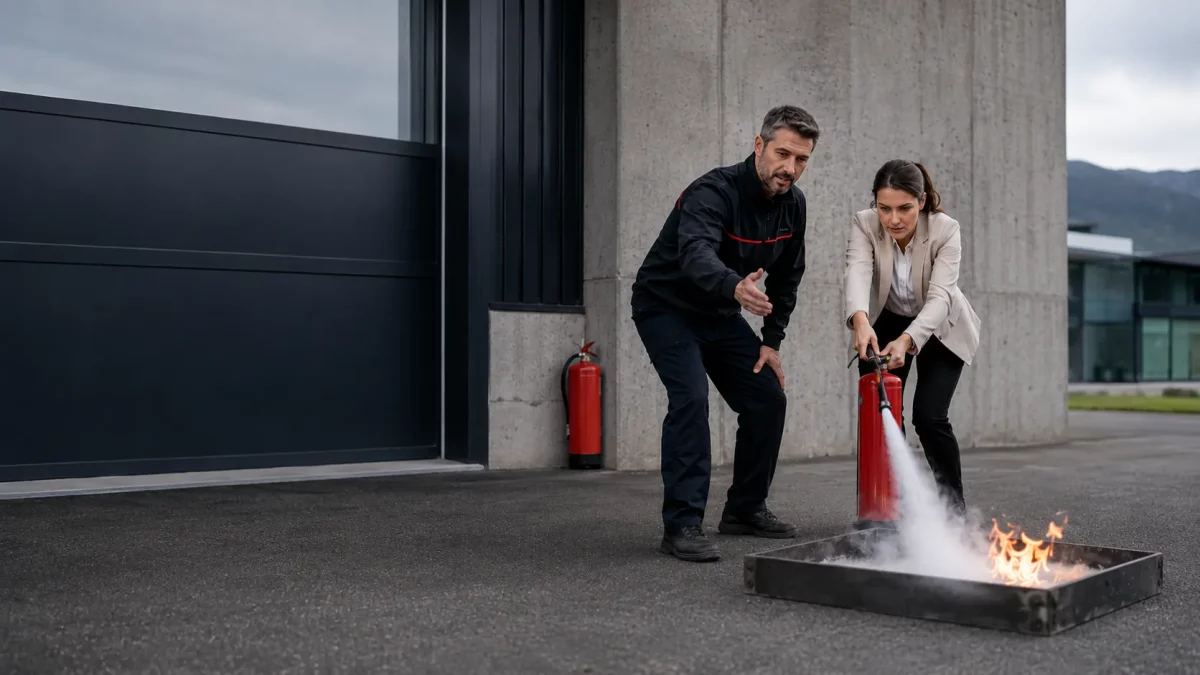
Table of contents
Yes, fire safety training is mandatory in Switzerland. Several federal and cantonal legal texts require it of every employer: the LAA (Art. 82), the OPA (Art. 40 para. 2) and the AEAI fire safety regulations. In French-speaking Switzerland, the cantons of Vaud, Geneva, Fribourg and Valais each have their own complementary legal bases. In the event of non-compliance: civil and criminal liability, as well as the risk of refusal of insurance compensation.
Introduction
Is fire safety training really mandatory, or merely recommended? This is the question many HR managers and SME executives in French-speaking Switzerland are asking. The answer is clear: it is mandatory for every company, regardless of its size.
Swiss law leaves no room for ambiguity. From the moment they hire their first employee, employers have a legal duty to instruct their staff on how to behave in the event of a fire. This is not a best-practice recommendation – it is a requirement set out in several legal texts.
This guide explains exactly what the law says, which companies are affected and how to bring your company into compliance in practical terms.
What Swiss law says about fire safety training
The Swiss legal framework is based on three pillars: the LAA, the OPA and the AEAI regulations. These texts complement one another and apply simultaneously.
The LAA and the duty to prevent accidents
The Federal Act on Accident Insurance (LAA) establishes the general principle in Article 82:
The employer is required to take, in order to prevent occupational accidents and diseases, all measures that experience has shown to be necessary, that the state of technology makes it possible to apply and that are appropriate to the given conditions.
In other words, if experience shows that fire safety training reduces risks – and there is no question that it does – the employer has a legal obligation to implement it. The LAA applies to all Swiss companies without exception.
AEAI fire safety regulations
The Association of Cantonal Fire Insurance Establishments (AEAI) issues the fire safety regulations that serve as the reference throughout Switzerland. AEAI Directive 12-15 (Fire Prevention and Organisational Fire Protection) is explicit:
- Staff must be informed and instructed about the fire hazards specific to the operation
- Particular attention must be paid to new employees
- The company must organise fire safety drills under conditions as close to reality as possible
- Employees must be instructed in the use of firefighting equipment
These AEAI regulations have the force of law in all Swiss cantons through cantonal fire insurance legislation.
Please note: the AEAI is currently working on the FPR 2026 (new Fire Protection Regulations), which will gradually enter into force and further strengthen organisational requirements.
Find out more: Legal obligations relating to fire safety
Cantonal ordinances (VD, GE, FR, VS)
In French-speaking Switzerland, the cantons have adopted their own complementary legal bases:
Vaud – ECA Vaud (the cantonal insurance establishment) monitors compliance with fire protection measures. The ECA Vaud guide specifies that training must be provided as a priority to new employees and repeated regularly, with an average frequency of once a year. Find out more on our dedicated page about fire safety and evacuation training in the canton of Vaud.
Geneva – Fire protection is governed by the LPSSP (Law on the Prevention of Incidents, the Organisation and Intervention of the Fire Service, F 4 05) and its implementing regulations, as well as by the LCI (L 5 05). The OAC – Fire Police is the competent authority.
Fribourg – The canton applies the AEAI regulations through its own cantonal legislation. Fribourg companies are subject to the same obligations to instruct their staff.
Valais – The Ordinance on Preventive Fire Protection Measures (540.102) and the Law on Protection Against Fire and Natural Hazards (540.1) form the cantonal framework. Every person is responsible, within the scope of their activities, for taking measures to prevent fires.
The OPA (Art. 40 para. 2) – Applicable across all cantons, the Ordinance on the Prevention of Accidents (RS 832.30) requires employers to instruct workers at suitable intervals on:
- the obligation to report a fire as soon as it is discovered
- the evacuation of persons in danger
- rescue and firefighting measures
Which companies are affected?
All of them. There is no minimum headcount below which an employer would be exempt. However, the extent of the obligations varies according to the type of activity and the associated risks.
| Type of company | Applicable obligation | Recommended frequency | Risk in case of non-compliance |
|---|---|---|---|
| SMEs in all sectors (< 50 employees) | LAA Art. 82 + OPA Art. 40 para. 2 + AEAI | Once a year | Civil liability, partial refusal of insurance coverage |
| Industry / warehouses / workshops | LAA + OPA + AEAI + cantonal ordinances | 1–2 times a year | Possible criminal liability, administrative closure |
| Public-access premises (hotels, restaurants, shops, nursing homes) | LAA + OPA + AEAI + specific regulations | 1–2 times a year | Withdrawal of operating licence |
| Offices / services | LAA Art. 82 + OPA Art. 40 para. 2 | Once a year | Civil liability in the event of a loss |
| Buildings open to the public or accommodating vulnerable persons | AEAI 12-15 section 6.3 (mandatory evacuation) | 1–2 times a year + evacuation drill | Compliance order, emergency measures |
| Large companies (> 250 employees) | LAA + OPA + AEAI + internal emergency plan | 1–2 times a year + regular drills | Criminal liability of company directors |
Mandatory fire safety training therefore applies from the first employee. The greater the risks associated with the activity (flammable products, high occupancy levels, premises that are difficult to evacuate), the stricter the requirements.
What must compliant fire safety training cover?
Compliant mandatory workplace fire safety training in line with AEAI regulations and the OPA must cover at least the following points.
1. Prevention and risky behaviour Identify ignition sources, flammable materials and dangerous behaviour to be avoided on the premises.
2. Detection and alarm Recognise alarm signals, know how to alert the emergency services (118), and deliver a clear and complete alert message.
3. Evacuation Know the evacuation routes and assembly point, as well as the procedures for evacuating persons with reduced mobility or vulnerable persons.
4. Using fire extinguishers Choose the right extinguisher for the type of fire (Class A, B, C or F), master the correct operating procedures and understand the limits of intervention.
5. Behaviour in the event of a fire Close doors to contain the fire, do not use lifts, do not go back, and protect yourself from smoke.
6. Internal organisation Know the role of designated personnel (evacuation officer, first-response team member) and where safety systems are located (gas valves, electrical shut-offs).
AEAI Directive 12-15 specifies that this training must be adapted to the employee’s actual work environment – not merely theoretical.
How often should fire safety training be provided?
The law does not set a single annual frequency. It refers to suitable intervals (OPA Art. 40 para. 2). In practice, the ECA Vaud guide and the AEAI regulations converge on a practical standard:
- Once a year for most companies
- Twice a year for high-risk activities or activities with high staff turnover
- Whenever a new employee joins: targeted priority instruction is mandatory
- After an incident or evacuation drill: a debriefing and refresher session are strongly recommended
The frequency must be defined by management, taking three factors into account: staff turnover, the level of staff knowledge and the risks associated with the activity.
Always record training in a dedicated register. The ECA Vaud guide explicitly recommends keeping a tracking document containing dates, topics, trainers and the list of participants. This register is your evidence in the event of an inspection or incident.
Risks of non-compliance
Failing to train your staff exposes the company to serious and tangible consequences.
Civil liability If a fire occurs and it is established that the staff had not been trained, the company may be required to compensate victims – employees, third parties and neighbours. The amounts can be very substantial.
Criminal liability In the event of a serious incident involving victims, company directors may face criminal proceedings for endangering the lives of others or for gross negligence.
Refusal or reduction of insurance compensation This is often the most immediate risk. If the insurer proves that fire safety regulations were not complied with, it may reduce its benefits, apply an increased deductible or even refuse all or part of the compensation.
Administrative measures The cantonal authorities (ECA, Fire Police) may issue a compliance order, impose a deadline for compliance or, in serious cases, order the closure of premises or revoke an operating licence.
Reputational damage A poorly managed fire, a chaotic evacuation and injuries among staff can have human and media consequences that far exceed the legal penalties.
How to bring your company into compliance
Here are the practical steps to meet Swiss legal fire safety requirements:
Step 1 – Assess your risks: Identify high-risk areas, flammable materials present, the layout of your premises and the profile of your employees.
Step 2 – Appoint a fire safety officer: Designate a person responsible for coordinating organisational fire protection. In SMEs, this is often the HR manager or safety manager.
Step 3 – Schedule training: Organise fire safety training for all staff, paying particular attention to new employees. Plan for annual refresher training.
Step 4 – Conduct an evacuation drill: Even a simple practical drill allows you to test the actual organisation and identify weaknesses before an incident does it for you.
Step 5 – Keep your register up to date: Record every training activity: date, topic, trainer, list of participants and observations. This document is your proof of compliance.
Step 6 – Use a certified provider: For SME fire safety training, a specialised provider supplies content compliant with AEAI regulations, training equipment (practice extinguishers, fire simulators) and a recognised certificate of participation.
SafetyFirst SA provides on-site fire safety training adapted to the reality of your company and compliant with the AEAI regulations in force. Our trainers operate throughout French-speaking Switzerland (VD, GE, FR, VS, NE, JU).
FAQ – Mandatory fire safety training in Switzerland
Is fire safety training mandatory for a company with three employees? Yes. The LAA (Art. 82) and the OPA (Art. 40 para. 2) apply from the first employee, with no minimum headcount. The training format may be simpler, but the obligation still exists.
What is the exact legal basis for the fire safety training requirement in Switzerland? Three main texts: LAA Art. 82 (general duty to prevent accidents), OPA Art. 40 para. 2 (specific fire safety instruction) and AEAI Directive 12-15. In French-speaking Switzerland, cantonal legislation (ECA Vaud, Geneva’s LPSSP and Valais Law 540.1) also applies.
How often must staff receive fire safety training? The law refers to «suitable intervals». In practice, once a year is the standard recommended by ECA Vaud and the AEAI regulations. New employees must be trained when they join the company.
What are the actual risks of failing to train staff? Civil liability in the event of an incident, criminal proceedings against directors if there are victims, partial or total refusal of compensation by the fire insurer, and administrative measures (compliance orders and closure of premises).
Must the training be delivered by an external provider, or can it be conducted in-house? Both are possible. The important thing is that the content covers the AEAI and OPA requirements and that the training is recorded in a register. An external provider supplies training equipment (practice extinguishers) and a recognised certificate.
Do the 2026 AEAI regulations change anything for SMEs? The FPR 2026 strengthen organisational requirements. The obligations to instruct staff remain fundamentally the same, but documentation and quality assurance will be subject to greater oversight. This is the right time to get your house in order.
Is an evacuation drill mandatory? AEAI Directive 12-15 (section 6.3) requires evacuation planning and drills for buildings that regularly accommodate members of the public or vulnerable persons. For other companies, a drill is strongly recommended and may be ordered by the cantonal authority.
Must written records of fire safety training be kept? Yes. The ECA Vaud guide explicitly recommends recording every training activity in a dedicated register (date, topic, trainer and participants). This document is essential in the event of an inspection or incident.
Useful sources
- OPA Art. 40 – Fedlex (RS 832.30) – Ordinance on the Prevention of Accidents, official text
- CFST Guide – Instruction of workers in the event of a fire – Official commentary on OPA Art. 40 para. 2
- AEAI – Fire safety regulations (bsvonline.ch) – AEAI regulations in force and draft FPR 2026
- Geneva – Fire protection laws and regulations (ge.ch) – LPSSP and LCI with implementing regulations
- Valais – Law on protection against fire (lex.vs.ch) – Cantonal legal basis in Valais