Is fire safety training mandatory in Switzerland?
01/06/2026
How to organise a fire evacuation drill at your company?
02/06/2026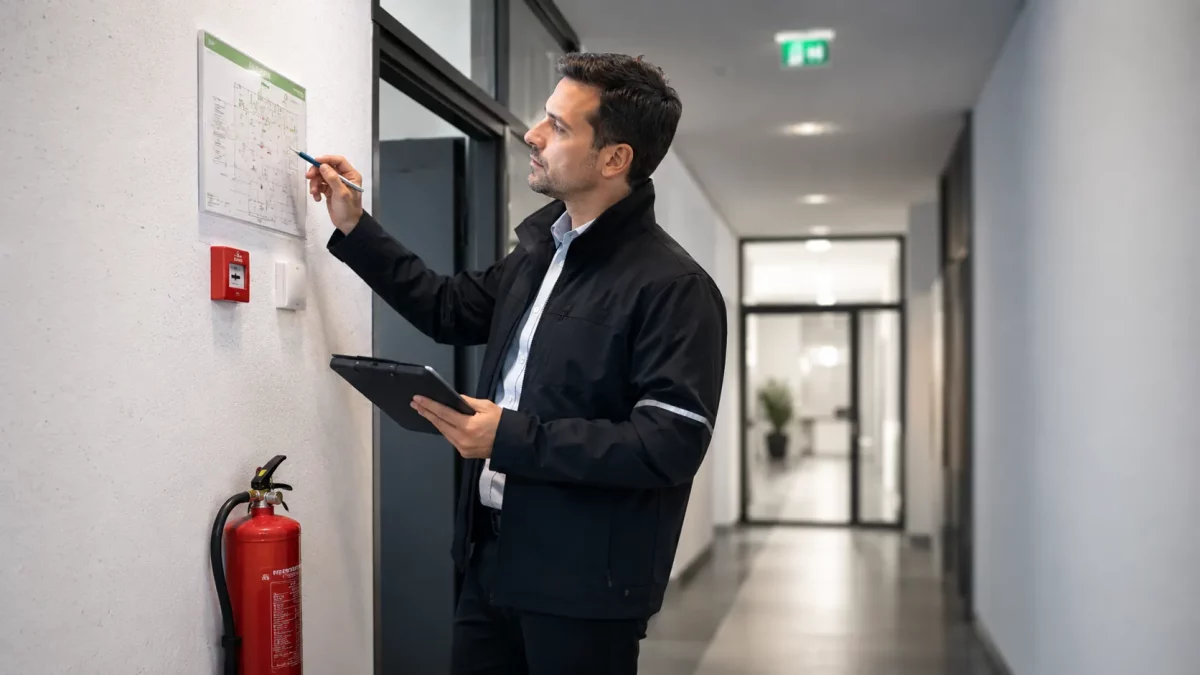
Table of contents
A fire safety officer (or BSI, Brandschutzbeauftragter in German) is the person appointed by the employer to manage fire safety at a facility. In Switzerland, appointing one is mandatory whenever the level of danger, number of occupants or type of activity requires it – in accordance with the AEAI 2015 Fire Protection Regulations, which apply in all cantons. The recognised training lasts 4 to 5 days and costs between CHF 1,500 and 1,790. Without such an appointment, the employer may face administrative sanctions and the risk of reduced or refused compensation in the event of a loss.
What is a fire safety officer?
The fire safety officer – abbreviated as BSI (from the German Brandschutzbeauftragter) – is the person appointed by management or the owner of a building to oversee the day-to-day implementation of fire safety measures.
Their role is operational and organisational: they do not design technical installations, but ensure that they function properly, that staff are trained and that evacuation procedures are in place.
Do not confuse this role with:
| Role | Scope |
|---|---|
| Fire safety officer (BSI) | Operational management of fire safety at the facility |
| Evacuation officer | Coordination of evacuation during an incident (often appointed by the BSI) |
| General safety coordinator (MSST) | Occupational safety in the broadest sense – accidents, ergonomics and hygiene |
| AEAI specialist / expert | Higher level of qualification, involved in complex construction projects |
Who can hold this position?
Anyone with recognised vocational training (CFC or equivalent) and at least one year of professional experience may sit the AEAI certification examination. The ideal candidate is a technical manager, facility manager, HSE manager or team leader with a good knowledge of the premises.
Is a fire safety officer mandatory in Switzerland?
Legal framework
Three texts form the legal basis:
- AEAI 2015 Fire Protection Regulations (Association of Cantonal Fire Insurance Establishments): declared mandatory in all Swiss cantons by the AIET. They establish the obligation to appoint a BSI “whenever the fire hazard, number of occupants, type or size of the facility requires it”.
- Art. 82 of the Federal Accident Insurance Act (Federal Act on Accident Insurance): requires employers to take all preventive measures permitted by experience and the state of the art.
- FCOS directives (Federal Coordination Commission for Occupational Safety): specify the employer’s organisational obligations regarding safety.
Mandatory thresholds
There is no single universal threshold. The obligation depends on several combined criteria:
| Criterion | Threshold / situation triggering the obligation |
|---|---|
| Number of occupants | > 300 people in a room or area (the concept of a “large number of people” under the AEAI standard) |
| Type of use | Residential care facilities, hotels, industrial sites and large retail stores: obligation is generally systematic |
| Fire load / hazardous materials | As soon as flammable or hazardous materials are stored or used |
| Number of storeys / building geometry | High-rise or complex multi-storey buildings |
| Building permit requirements | Certain projects require a BSI from the operational phase onwards |
Special cases
- Residential care facilities and care institutions: enhanced requirements apply because of the need to protect people with reduced mobility or those who depend on assistance. A BSI is almost always required.
- Hotels: specific organisational obligations apply from 20 guests onwards. A BSI is strongly recommended and often required.
- Industrial sites: the presence of hazardous materials, high-risk processes or a high fire load triggers the obligation regardless of the size of the facility.
- Large retail stores: customer flows and floor area require the appointment of a BSI.
What the employer risks if one is absent
- Corrective measures imposed by the cantonal fire safety authority
- Restriction or prohibition of operations in certain premises
- Reduction or refusal of compensation by the building insurer in the event of a loss, if non-compliance is proven
- Civil liability of the operator if the failure contributed to the damage
- In serious cases: criminal liability of the company director
See our article: Legal obligations relating to fire safety
What are the concrete duties of a fire safety officer?
What they do
- Regularly inspects the premises: clear evacuation routes, compliant signage and accessible fire extinguishers
- Keeps the fire safety logbook: staff training, evacuation exercises and installation checks
- Organises and documents evacuation exercises (at least once a year in most facilities)
- Trains and raises staff awareness of emergency instructions and evacuation procedures
- Keeps evacuation and rescue plans up to date (including plans for the fire service)
- Coordinates with the fire service during exercises and in the event of an incident
- Checks that detection systems, sprinklers, smoke extraction systems and emergency lighting are functioning properly (without carrying out technical maintenance)
- Reports to management any deviation from the AEAI regulations
What they do NOT do
- They do not replace firefighters or approved technicians responsible for periodic inspections of installations
- They do not prepare fire safety concepts for new buildings (this is the role of the AEAI specialist or expert)
- They do not carry out technical maintenance on sprinklers, detectors or alarm control panels
What training is required to become a fire safety officer?
AEAI certification – the national benchmark
Standard fire safety training is not sufficient here.
The AEAI / VKF certification (Vereinigung Kantonaler Feuerversicherungen) is the qualification recognised throughout Switzerland. It is organised by the AEAI and accredited according to ISO/IEC 17024.
Certification examination:
- Duration: 120 minutes, written examination
- Location: Bern (Universal Postal Union)
- Next examination: 12 May 2026
- Registration possible from 1 September 2025, deadline 12 February 2026
- Permitted materials: AEAI directives, FCOS/SUVA documents in paper format only
Admission requirements:
- Vocational training with a recognised qualification (CFC or equivalent)
- At least 1 year of professional experience
Certificate validity: 5 years, renewable upon submission of evidence of continuing education and active practice in the field.
Cantonal training courses
Several cantonal fire insurance establishments offer their own training courses:
- ECA Vaud: “Fire Safety Officer” training focused on organisational measures, intended for facilities and companies. Continuing education modules are organised once or twice a year (January and/or June), with each module counting as 2 continuing education units towards renewal of the AEAI certificate.
- GVB Bern (Gebäudeversicherung Bern): training courses and resources are available via gvb.ch
- Swiss Safety Center: provides an SAS-accredited certification recognised as equivalent to the AEAI certificate
Refresher training and maintaining competence
The AEAI certificate requires the following for renewal every 5 years:
- A minimum of 2.5 days of recognised continuing education during the period
- Evidence of active professional practice in the field during the previous 2 years
In practice, annual updating is recommended to keep up with changes to AEAI regulations and cantonal directives.
Compliant training vs internal awareness training
| AEAI-compliant training | Internal awareness training | |
|---|---|---|
| Recognised certification | ✅ Yes | ❌ No |
| Valid in all cantons | ✅ Yes | ❌ No |
| Covers legal requirements | ✅ Complete | ⚠️ Partial |
| Sufficient for the authorities | ✅ Yes | ❌ No |
| Cost | CHF 1,500–1,790 | Variable |
Internal awareness training can complement the training, but does not replace AEAI certification for facilities subject to a legal obligation.
How do you appoint and integrate a fire safety officer into your company?
Practical steps
1. Identify the person Choose an employee who knows the premises well, has sufficient authority and can set aside time for this role. A technical manager or facility manager is often the ideal candidate.
2. Formal appointment and letter of assignment The appointment must be in writing. Draw up a letter of assignment specifying:
- The geographical scope covered (building(s), site(s))
- Responsibilities and duties
- Allocated resources (time, budget, access to the premises)
- Direct reporting line
3. Integration into the organisational chart The fire safety manager must appear in the company’s organisational chart, with a direct reporting line to management. This visibility is essential so that they can exercise their authority in an emergency.
4. Training and certification Send the appointed person to preparatory training (4–5 days), followed by the AEAI certification examination. Plan everything sufficiently far in advance: examination sessions are held annually.
Tools to provide from the start
- Fire safety logbook: record of all actions (training, exercises, inspections and incidents)
- Up-to-date evacuation and rescue plans, displayed and sent to the fire service
- Periodic inspection checklist for the premises (evacuation routes, fire extinguishers, signage and installations)
- Access to AEAI directives and applicable cantonal regulations
Frequency of evacuation exercises
| Type of facility | Recommended frequency |
|---|---|
| Standard office / SME | Once a year |
| Residential care facility, hospital or care institution | At least twice a year |
| Hotel | Once or twice a year, depending on the cantonal authority |
| High-risk industrial facility | Twice a year |
Each exercise must be documented in the safety logbook: date, participants, duration, observations and corrective measures.
For more information on this topic: Guide to organising a workplace evacuation exercise
FAQ
Can a fire safety officer be external to the company?
Yes. The AEAI regulations do not require the BSI to be an internal employee. An external AEAI-certified provider may take on this role, provided they hold a recognised certificate of competence and are formally appointed in writing. This solution is particularly suitable for SMEs that do not have the resources to train an employee internally. Check that the provider is active and that their certification is up to date (valid for 5 years).
How much does fire safety officer training cost?
The preparatory training (4- to 5-day course) costs between CHF 1,500 and CHF 1,790, depending on the provider. The AEAI certification examination is charged separately (check the examination fee directly with the AEAI – the late cancellation fee is CHF 50). You should therefore budget approximately CHF 1,600 to 1,900 per person, excluding travel and accommodation costs.
What is the difference between a fire safety officer and a safety coordinator?
The fire safety officer (BSI) specialises exclusively in fire safety: they apply the AEAI regulations, train staff, manage evacuation plans and maintain the logbook. The safety coordinator (or MSST manager) covers occupational safety in the broadest sense – accidents, ergonomics, chemicals and more – in accordance with the Federal Accident Insurance Act and FCOS directives. The two roles can be held by the same person in an SME, but they are separate mandates requiring different training.
Does my 10-person company need one?
Not necessarily, if your activity presents no particular risk and your premises accommodate fewer than 300 people. That said, even below the formal mandatory thresholds, a fire safety officer – even without certification – remains useful for organising evacuation exercises and maintaining equipment. If your company stores flammable materials, welcomes members of the public or occupies a multi-storey building, consult your cantonal ECA to verify your exact obligations.
Does the appointment have to be in writing?
Yes. An oral appointment has no evidentiary value vis-à-vis the authorities or the insurer. The written letter of assignment, signed by management and the BSI, is essential. It must specify the scope, responsibilities and allocated resources. Keep it in the fire safety logbook.