


Courses available in FR · EN · DE



Course overview
- Alert
- Protect
- Resuscitate
- Collaborate
- Assess
- Coordinate
Training locations
The first aid training for deaf and hard-of-hearing people is offered throughout Switzerland, with sessions organised in French-speaking Switzerland and German-speaking Switzerland. SafetyFirst delivers the training directly at institutions, companies, specialised schools and associations, ensuring a familiar environment adapted to the participants.
Training can also be organised in accessible training rooms, providing good visibility, optimal visual communication and realistic practical exercises. This flexibility encourages active participation and a better understanding of first aid techniques.
Practical information
- Duration: 1 day
- Participants: maximum 12 people per session to ensure personalised instruction
- Prerequisites: none
- Format: classroom-based, with a strong practical focus and adapted visual materials
- Training languages:
- 🇫🇷 French
- 🇬🇧 English
- 🇩🇪 German
- Accessibility: training designed to meet the needs of deaf and hard-of-hearing people
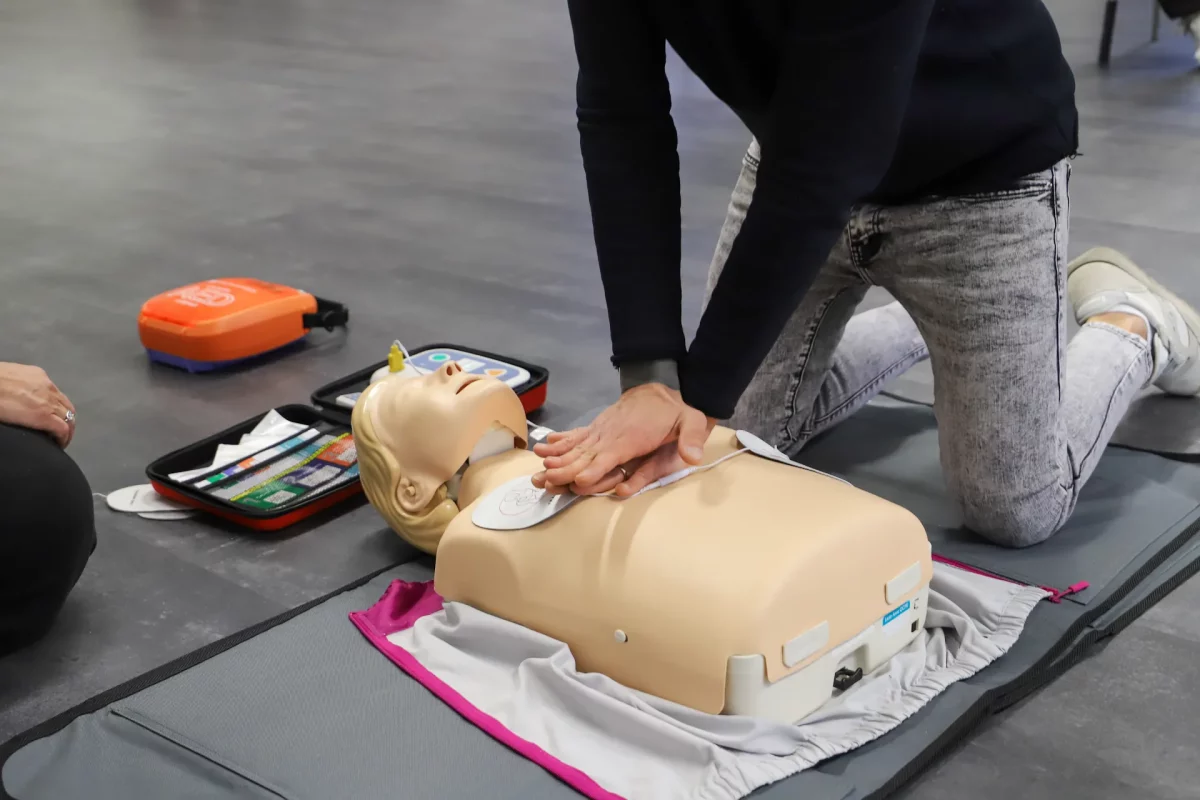
- Materials provided: visual materials, manikins, training AEDs and adapted communication tools
- Certificate: SafetyFirst certificate of attendance – First aid for deaf and hard-of-hearing people
Lifesaving skills made accessible to everyone through adapted communication
The first aid training for deaf and hard-of-hearing people has been designed to make lifesaving skills accessible, understandable and applicable in real-life situations. It takes into account the specific requirements of visual communication and the challenges encountered during an emergency. Over the course of one day, participants learn how to respond to common situations such as illness, choking and trauma, perform CPR and use an AED, while mastering appropriate alert and communication methods for deaf and hard-of-hearing people.
Target audience
This training is primarily intended for deaf and hard-of-hearing people, as well as professionals who may need to interact with them in an emergency:
- Deaf or hard-of-hearing people, regardless of their preferred communication method
- Professionals and responders working with deaf or hard-of-hearing people:
specialist educators, teachers, reception staff, activity leaders and social workers - Employees of companies and institutions wishing to improve their ability to communicate and respond effectively when assisting a deaf person in an emergency
- Anyone wishing to develop inclusive first aid skills
No prerequisites are required. The training is adapted to the participants’ level and needs.
Learning objectives
By the end of the training, participants will be able to:
- Understand the specific communication requirements in emergency situations related to deafness
- Quickly recognise an emergency requiring intervention
- Perform essential first aid techniques independently and safely
- Perform cardiopulmonary resuscitation (CPR) and use an AED
- Adapt their visual communication to reassure, inform and coordinate the response
- Alert the emergency services effectively despite hearing-related constraints
- Use adapted tools and resources such as applications, written messages and pictograms
- Take part in team interventions through clear and structured communication
The aim is to enable participants to become active responders, capable of acting with confidence and effectiveness.
Course content
The training takes place over one day, with a strong practical focus and adapted materials.
- Communication and safety in emergency situations
- Specific features of visual communication in stressful situations
- Environmental awareness and visual attention
- Safety rules for the first aider and the casualty
- Adapted first aid techniques
- Rapid assessment of the situation and the casualty’s condition
- Protection, alert and initial care
- Managing common emergencies:
illness, loss of consciousness, choking, burns and trauma
- Resuscitation and AED use
- Adapted CPR with a step-by-step visual demonstration
- Use of an AED, including understanding visual and voice prompts
- Working in pairs and non-verbal coordination
- Alerting and communicating with the emergency services
- How to alert 144 if deaf or hard of hearing
- Using emergency communication applications and SMS
- Clearly communicating essential information in writing or through pictograms
- Adapted tools and resources
- Introduction to digital tools useful in emergency situations
- Basic simplified sign language as applied to first aid
- Visual materials that facilitate rapid understanding
- Practical exercises and role plays
- Practical scenarios adapted for deaf and hard-of-hearing participants
- Visual communication and team coordination exercises
- Group debriefing and personalised advice

EXCELLENT Basée sur 1366 avis
 Publié sur Google
 khaled salloumC’était une très bonne formation pleine d’informations utiles merci beaucoupPublié sur Google
 Maciej KozłowskiFormation très intéressante et instructive. Merci.Publié sur Google
 Maiena ArrayetSuper formation réalisée aujourd'hui en entreprise grâce à Safety First. C'était très intéressent et interactif, avec de réels entraînements.Publié sur Google
 Faicel EL MHIRITop formationPublié sur Google
 Daniela Rodriguescyril et steve au top!Publié sur Google
 Richard Erick Songgreat explanation and demonstrationPublié sur Google
 Jade AbrialSuper expérience encore merci pour cette super formationPublié sur Google
 Said MouminiExcellent formation.
We're here to give you personalised help.
Fill in this form and our team will guide you towards the ideal option for your requirements.

Certified trainers, ready to deliver training courses.
Success rate of training participants.
Average rating given by participants.
Companies trained in health and safety at work.
Certified trainers, ready to deliver training courses.
Success rate of training participants.
Average rating given by participants.
Companies trained in health and safety at work.
Your advantages with SafetyFirst

Interactive training
Our training courses combine interactivity and practice for a dynamic and engaging safety learning experience.

Customised training
We value your time: courses are scheduled around your availability to minimise operational disruption.

Certified Training
We incorporate international safety standards, finely tuned to your company’s local specifics.
Why choose SafetyFirst for inclusive first aid training?
SafetyFirst is committed to making first aid techniques accessible to everyone, including deaf and hard-of-hearing people. This training has been designed with teaching methods adapted to visual communication, clear materials and realistic practical exercises. The trainers are aware of accessibility issues and favour a supportive, structured and practical approach. Small groups allow for personalised support and adaptation to the participants’ preferred communication methods. Available in French, English and German, this training contributes to genuine inclusion in prevention and safety.
Related training:
Preparing today, protecting tomorrow.
#SafetyFirst #Training #Prevention #Health #Safety
FAQ: First aid for deaf and hard-of-hearing people
Deaf or hard-of-hearing people, as well as professionals and employees who may need to respond to or communicate with them in an emergency.
Yes. The content is designed to be understood through visual materials, practical demonstrations and adapted communication.
Yes. Participants learn cardiopulmonary resuscitation (CPR) and how to use a defibrillator, with step-by-step visual explanations.
The training covers adapted alert solutions, such as emergency SMS, dedicated applications and written communication tools.
Yes. It is also intended for professionals wishing to improve their communication and effectiveness when responding to an emergency involving a deaf person.
The training is available in French, English and German, depending on the needs of the teams.
Yes. A SafetyFirst certificate of attendance is issued at the end of the training.
