Practical Guide to Treating a Minor Wound
20/09/20242025 Comparison: Which First-Aid Course Should You Choose: BLS-AED-SRC, IAS 1 or IAS 2?
02/10/2024Every year in Switzerland, thousands of lives could be saved if more people were familiar with basic first aid. In the event of cardiac arrest, the response of a bystander—whether trained or not—can mean the difference between life and death. Yet many people hesitate to intervene for fear of doing something wrong.
Using an automated external defibrillator (AED) is simple, guided and accessible to everyone. However, you need to know how to recognise an emergency, act quickly and follow the correct steps.
In this article, you will discover how to use an AED effectively in a critical situation, which reflexes to adopt and why it is essential to learn cardiopulmonary resuscitation through a programme such as BLS-AED-SRC. Whether you are a private individual concerned about protecting your loved ones or a professional looking to improve workplace safety, this guide will help you become an active link in the chain of survival.
1. What is a defibrillator (AED) and when should it be used?
The automated external defibrillator—more commonly known as an AED—is a portable medical device designed to restore a normal heart rhythm in the event of sudden cardiac arrest. It automatically analyses the heart rhythm and, if necessary, delivers an electric shock (defibrillation) to restore cardiac activity.
These devices are now widely available throughout French-speaking Switzerland: at railway stations, in businesses, sports centres, schools and more. Their presence has become widespread, but their effectiveness depends above all on how quickly the bystander intervenes.
An AED should only be used in specific situations:
- The person is unconscious
- They are not breathing normally (gasping or no breathing)
- They do not respond to stimulation
This is when every second counts. The device provides voice guidance to the user at every stage. Even without prior training, it is possible to take action. However, BLS-AED-SRC certified training improves effectiveness and composure, enabling you to intervene confidently from the very first seconds.
2. Recognising cardiac arrest: the unmistakable signs
Rapidly identifying a life-threatening emergency is crucial to activate the chain of survival without delay. Sudden cardiac arrest gives no warning: it occurs abruptly and requires immediate action.
Typical signs of cardiac arrest
Cardiac arrest should be suspected if the person:
- Suddenly loses consciousness
- Does not respond to any stimulus (speech, shaking or pain)
- Is not breathing or has abnormal breathing (gasping or struggling to breathe)
Do not try to feel for a pulse: this step is reserved for healthcare professionals. The absence of a response and normal breathing is sufficient to suspect cardiac arrest.
What should you do immediately?
- Call 144: this is the emergency services number in Switzerland.
- Start cardiopulmonary resuscitation (CPR): give 30 deep chest compressions followed by 2 rescue breaths (if trained), or continuous chest compressions otherwise.
- Request an AED: if a defibrillator is available, have someone bring it and switch it on as soon as it arrives.
Every minute without chest compressions or a defibrillation shock reduces the chances of survival by 7 to 10%. Acting quickly gives the victim a real chance of survival.
3. Detailed steps: how to use an AED
A defibrillator (AED) is designed to be intuitive to use. Thanks to its voice and visual instructions, anyone can use it effectively, even without prior training. Nevertheless, knowing the steps in advance builds confidence and reduces stress.
Switch on the device immediately
As soon as you receive the AED, switch it on by pressing the relevant button or simply opening the lid, depending on the model. The device will provide verbal guidance for the rest of the intervention.
Remove the victim’s clothing and prepare them
Remove clothing from the upper body to expose the chest. If the chest is wet from rain or perspiration, dry it quickly. If necessary, shave excessive hair with the kit provided to ensure that the pads adhere properly.
Position the pads correctly
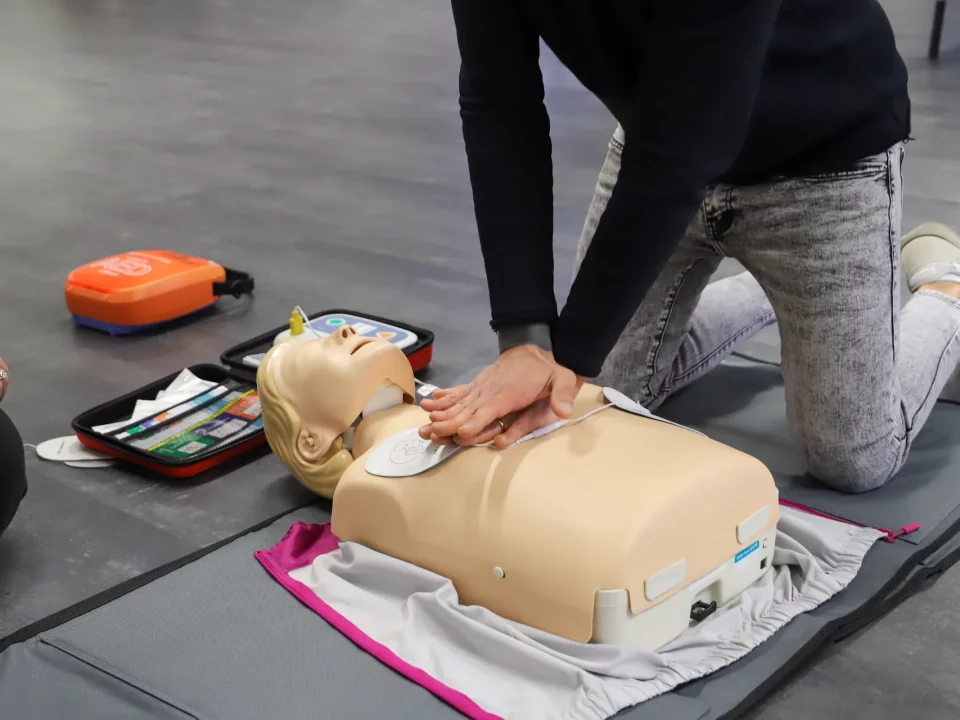
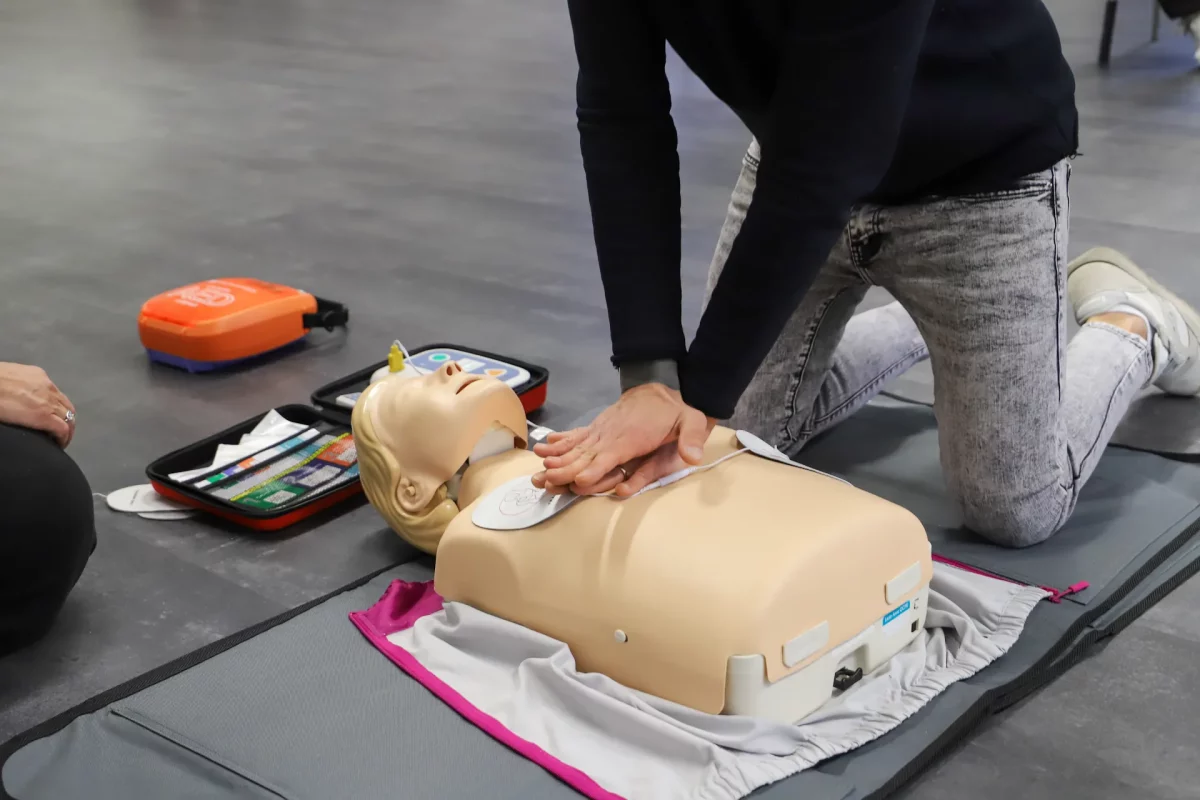
Attach the two pads according to the diagrams shown:
- The first below the right collarbone
- The second on the left side of the chest, below the armpit
Make sure they are firmly attached to the skin.
Start the analysis and deliver the shock
Once the pads are in place, the AED will analyse the heart rhythm. Do not touch the victim during this phase. If a shock is advised, press the button when prompted. Then immediately resume chest compressions.
Continue resuscitation until help arrives
Continue CPR by following the AED’s voice instructions. Alternate between compressions and defibrillation shocks if necessary, until the victim shows signs of recovery or emergency services take over.
Key steps for using a defibrillator (AED) in an emergency
- Switch on the AED as soon as it arrives
Press the button or open the lid to activate the device. It will immediately begin guiding you. - Expose the victim’s chest
Remove their clothing and make sure the skin is dry. Use the razor provided if necessary. - Apply the adhesive pads
Position them according to the diagram: one below the right collarbone and the other on the left side of the chest. - Let the device analyse the heart rhythm
Do not touch the victim. The AED automatically determines whether a shock is necessary. - Press the shock button if advised
Make sure no one is touching the victim, then deliver the shock by following the instructions. - Immediately resume chest compressions
Continue CPR until emergency services arrive or the victim shows signs of recovery.
Discover our BLS-AED-SRC life-saving skills training >
4. What should you do after using an AED?
Once the AED has been used and emergency services are on their way or already present, certain steps are essential to ensure comprehensive care for both the victim and the responder.
Inform emergency services when they arrive
As soon as the professionals arrive, provide them with the following information:
- The number of shocks delivered by the AED
- The approximate duration of the resuscitation
- The victim’s reactions during the intervention
This information enables emergency medical teams to adjust their protocol based on what has been done at the scene.
Maintain the device after use
An AED that has been used must be checked promptly:
- Used pads must be replaced
- The battery condition must be checked
- The device must be restored to working order for future use
In the workplace, this check is often carried out by the person responsible for safety or medical equipment. Visit our AED sales and maintenance page >.
Consider psychological support
Intervening during a cardiac arrest can be emotionally challenging, even when the procedure has been followed correctly. It is advisable to talk to colleagues or a first aid trainer, or to consult a professional if needed. Some BLS-AED-SRC courses also include modules on managing post-intervention stress.
5. Why BLS-AED-SRC training is essential
Knowing how to use an AED in a real-life situation cannot be improvised. Even though the device is designed to guide the user by voice, only certified training enables you to act more quickly and precisely while remaining calm.
Structured, supervised learning
The BLS-AED-SRC course (Basic Life Support – Automated External Defibrillator), accredited by the Swiss Resuscitation Council, teaches:
- How to recognise vital signs
- How to perform chest compressions and rescue breaths
- How to use an AED safely
- How to coordinate with professional emergency services
The sessions include practical exercises on manikins, realistic scenarios and practical advice on managing the stress and emotions associated with emergency interventions.
A certification recognised in Switzerland
The BLS-AED-SRC certificate is valid for 2 years and recognised by health authorities and many companies. It represents a valuable professional skill, particularly in high-risk sectors, educational institutions and healthcare professions.
A civic act of solidarity
By completing training, you become an active link in the chain of survival. Every trained person increases the chances of survival for a loved one, colleague or even a stranger. It is a practical, accessible and useful action for everyone.
To find out more or register, visit our complete BLS-AED-SRC course.
6. The impact of your intervention on survival
In the event of cardiac arrest, every second is critical. Thanks to rapid intervention with an AED and appropriate resuscitation measures, a victim’s chances of survival can triple. Defibrillation within the first three minutes offers up to a 70% chance of recovery without major neurological impairment.
A vital role in the chain of survival
You are not merely a bystander: you become an active participant in emergency care. Your ability to raise the alarm, respond, resuscitate and use a defibrillator can mean the difference between a tragic outcome and a life saved.
Training as a catalyst for effectiveness
The better prepared you are, the faster and more precise your actions will be. BLS-AED-SRC training is not simply a course; it is a practical commitment to collective safety. At work, at home or in public spaces, being trained means accepting your share of responsibility for preventing avoidable deaths.
Conclusion: Train to be ready to save a life
Cardiac arrest is an absolute emergency that can affect anyone, anywhere. Having an AED nearby is not enough if no one knows how to use it correctly. Your preparation is what makes the difference.
By mastering first aid techniques and how to use a defibrillator, you become an essential link in the chain of survival. This skill, accessible to everyone, can transform a dramatic situation into a positive outcome.
Would you like to train and make a difference?
Discover our certified BLS-AED-SRC courses, available throughout French-speaking Switzerland: Geneva, Lausanne, Fribourg, Neuchâtel, Valais and Jura.
To deepen your knowledge or explore all the training options available, visit our complete guide to first aid training in French-speaking Switzerland.
👉 Book your session now or contact our team to arrange an in-company session
FAQ: AEDs and first aid
What is the difference between an AED and a defibrillator?
There is no difference. AED (Automated External Defibrillator) is the English acronym, while the other term is the French equivalent. Both refer to the same device used to treat sudden cardiac arrest.
Can a member of the public use a public defibrillator?
Yes. In Switzerland, anyone is authorised to use an AED in an emergency. The device provides voice guidance at every step. However, completing BLS-AED-SRC training is strongly recommended to help you act calmly and effectively.
Where are defibrillators located in Switzerland?
They can be found at railway stations, shopping centres, airports, schools, businesses and busy public places. The www.defikarte.ch website helps you locate accessible AEDs near you.
Does an AED always deliver a shock?
No. The AED first analyses the heart rhythm. It only delivers a shock if it detects a rhythm disorder requiring defibrillation. It is therefore safe and cannot be misused.
Is training mandatory to intervene with an AED?
No, it is not mandatory, but it is strongly recommended. BLS-AED-SRC training enables you to develop the right reflexes and improve your effectiveness in a real-life emergency.