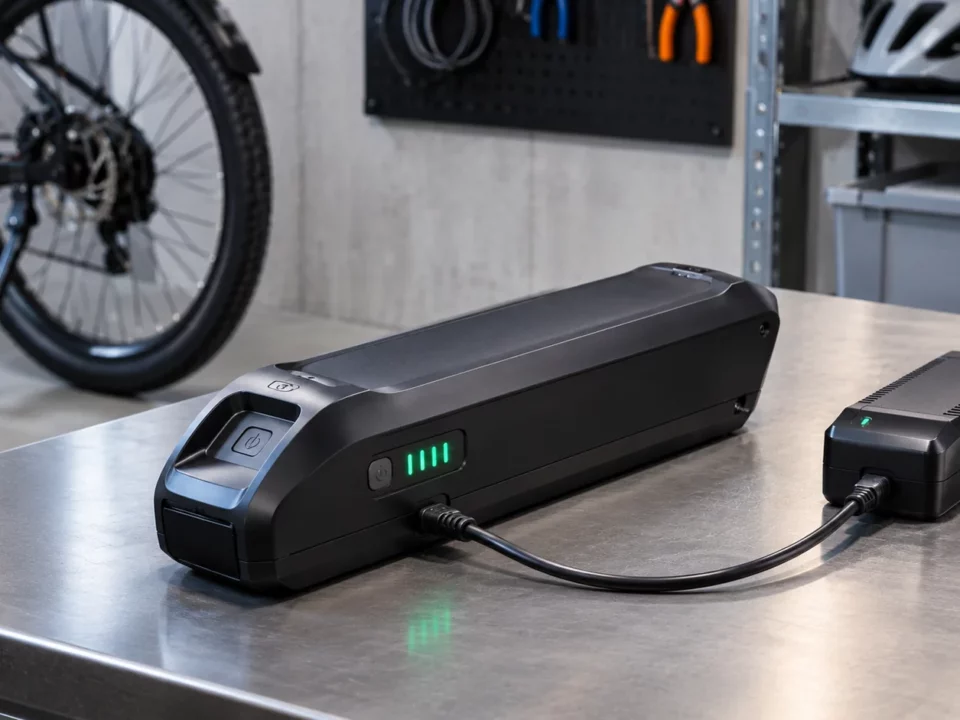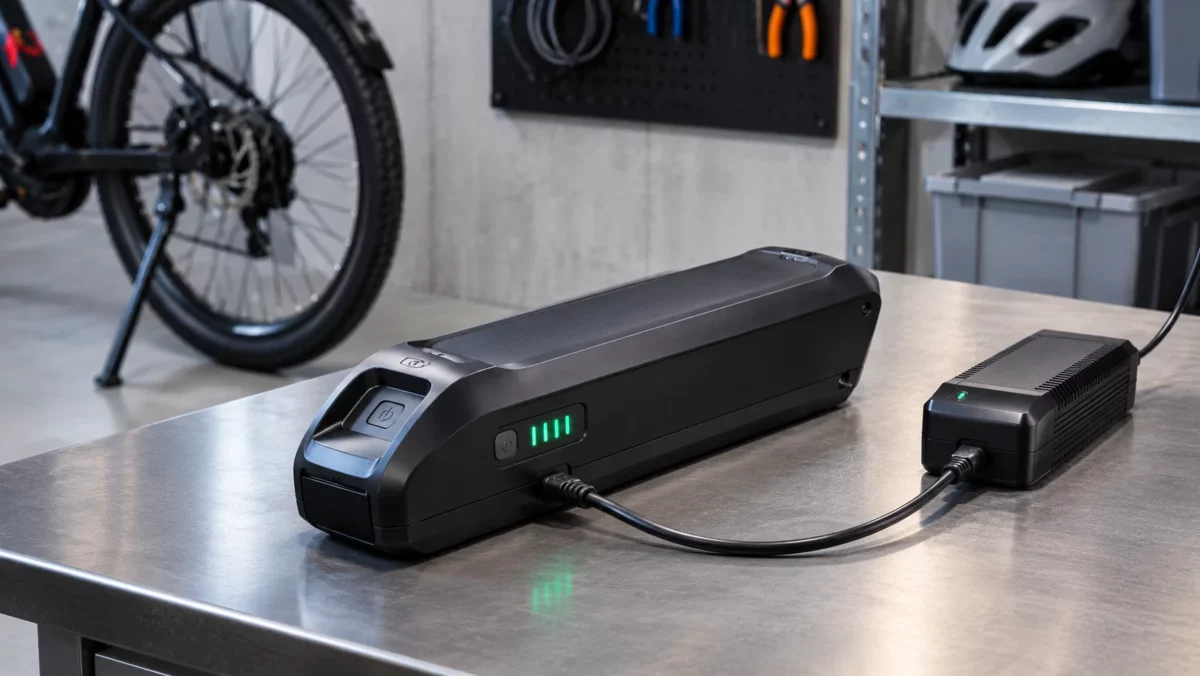
Lithium-ion battery fire: risks, prevention and safety advice
09/11/2026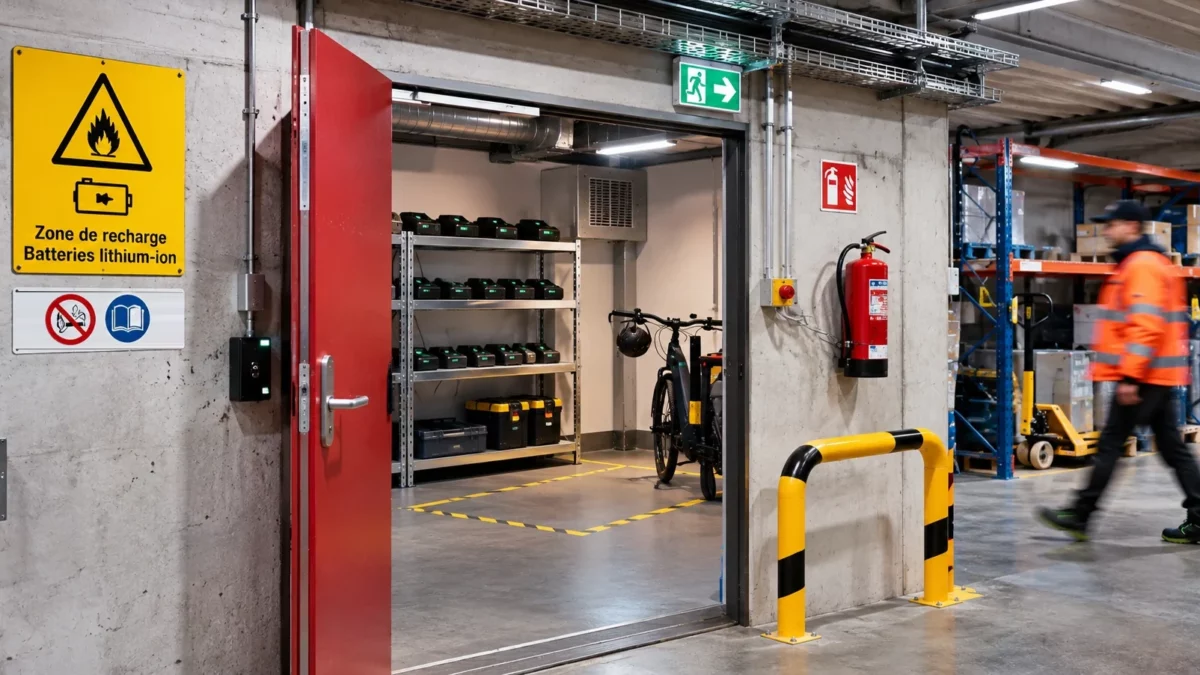
Professional guide Fire safety
In the workplace, lithium-ion batteries are no longer limited to computers and phones. They also power cordless tools, electric bicycles and scooters, cleaning equipment, certain handling equipment and energy storage systems.
When a battery is damaged or defective, it can overheat and, under certain circumstances, enter thermal runaway. If several batteries are grouped together or combustible materials are nearby, the consequences of an incident can be significant.
Where should a charging area be located? How do you choose a safety cabinet? What rules apply in Switzerland? This guide helps you inventory your equipment, organise charging, identify anomalies and prepare your organisation’s response in the event of an incident.
Guide contents
Contents
Lithium-ion battery storage in the workplace: what are the risks?
A lithium-ion battery contains energy even when it is stored and disconnected. When in good condition and used in accordance with the manufacturer’s instructions, it does not present the same level of risk as a deformed, improperly repaired or impact-damaged battery. The aim is therefore to distinguish ordinary use from situations requiring special precautions.
Why can a lithium battery catch fire while in storage?
An internal failure, short circuit, mechanical damage or excessive exposure to heat can cause abnormal heating. In the most serious cases, internal reactions reinforce one another: this is thermal runaway. It may be accompanied by gases, smoke, flames and projections.
A battery can behave this way even when it is not connected to a charger. This is one reason why a battery removed from a bicycle after an impact must not be considered safe based solely on its appearance.
To understand the mechanism, warning signs and safety procedures, see our first guide on lithium-ion battery fire risks. This guide focuses on the decisions to be made in a professional facility.
Charging and passive storage: what are the safety differences?
Passive storage refers to a battery stored without charging or discharging taking place. Charging introduces additional electrical and thermal constraints: the charger, connections, installation quality and the battery’s electronic management system then become relevant.
Poorly organised charging can contribute to an incident or delay its detection, for example when it takes place near cardboard or while the building is closed. Passive storage is not risk-free either, especially when batteries are numerous, damaged or exposed to unsuitable conditions.
List separately the areas where batteries are kept before use and those where they are charged.
Number of batteries, capacity in kWh and fire spread
The number of batteries alone is not enough to characterise an installation. You must also know their energy capacity, expressed in watt-hours (Wh) or kilowatt-hours (kWh), as well as their condition, technology and arrangement.
The combined nominal capacity (calculated in detail in the inventory) describes the stored energy. It measures neither the probability of a fire nor the risk category.
When several batteries are grouped together, an incident can expose nearby equipment to intense heat. The proximity of combustible materials, compartmentation and alarm systems then influence the possible consequences. This is why a small tool cabinet and a room housing a fleet of bicycles must not be assessed in the same way.
How should lithium battery risks be assessed in the workplace?
Before investing in protective equipment, list the batteries present on your premises. This initial step can often be carried out with internal teams and helps avoid choosing a solution that is oversized or, conversely, inadequate.
Creating an inventory of batteries and rechargeable equipment
Prepare a list of equipment by area: tools, computers, removable batteries, cleaning equipment, electric bicycles, stationary systems or handling equipment. Where the information is available, record the manufacturer, reference, technology, nominal capacity and charger specifications.
Add the actual conditions of use: location, charging frequency, overnight operation, inspection date and any known damage. Employees’ personal batteries should also be taken into account when they are regularly charged on the premises.
For a small business, a simple table updated regularly is enough to get started.
| Equipment | Number | Unit capacity | Nominal total | Location | Condition |
|---|---|---|---|---|---|
| Electric bicycle batteries | 20 | 500 Wh | 10 kWh | Charging room | To be checked regularly |
Calculation: number × unit capacity (Wh) ÷ 1 000 = kWh — e.g.: 20 × 500 Wh = 10 000 Wh = 10 kWh
The nominal total does not, by itself, constitute a regulatory risk classification.
Calculating the energy capacity of stored batteries
Capacity in Wh indicates an amount of energy. Charger power, expressed in W, describes an energy flow rate. The two units must not be confused.
To estimate the nominal energy present in an area, multiply the number of batteries by their unit capacity, then divide the total in Wh by 1,000 to obtain kWh. If the models differ, add the capacities of each group.
This estimate facilitates discussions with a safety manager, installer or fire safety specialist; it does not replace the application of the VKF thresholds specific to each installation category.
Identifying hazardous situations in offices, workshops and warehouses
Observing the premises often makes it possible to identify avoidable situations: batteries charged on cardboard boxes, chargers behind stored products, overloaded sockets, damaged cables or equipment placed in an evacuation corridor.
The assessment must also examine the ability to detect an incident quickly, disconnect a power supply without exposing anyone to danger and evacuate people. Buildings with several activities or large quantities of batteries may require a more structured analysis.
These questions form part of a broader occupational risk assessment, alongside electrical, chemical and work organisation risks.
Should employees’ personal batteries be included?
Yes, when a facility permits the charging of personal bicycles, scooters or devices. Internal rules should specify authorised locations, approved chargers and what to do if a battery is suspected of being defective.
It is often more effective to provide a clearly identified location than to let each employee find an available socket. The arrangement must nevertheless remain appropriate for the number of devices and the site layout.
Where should lithium-ion batteries be stored in the workplace?
A suitable location limits the stresses placed on batteries and the possible consequences of an incident. The right choice depends on their number, condition, storage duration and the use of the building.
Which room should be chosen for secure battery storage?
Choose a dry space with a temperature compatible with the manufacturers’ recommendations, protected from impacts and away from significant heat sources. Batteries must be placed stably, without risk of falling, being crushed or allowing accidental contact between exposed terminals.
Evacuation and rescue routes must remain clear. A stairwell, corridor or exit is not a suitable location for storing or charging batteries.
When capacities or quantities become significant, the characteristics of the room, its separation from other activities and its accessibility to emergency services become increasingly important factors in the choice.
What distances should be maintained between batteries and combustible materials?
Avoid placing batteries immediately next to cardboard, pallets, textiles, solvents and other combustible loads. A clear separation limits the possibility of fire spread and makes it easier to observe the equipment.
The VKF Guide 2005-15 specifies, among other things, a minimum distance of 2.5 metres from combustible materials for certain charging stations for small electric vehicles and certain multiple commercial charging installations (chapters 4.8 and 4.9). This figure must not be presented as a universal rule for all stored batteries, rooms or cabinets.
If this distance cannot be achieved, consider separation or protective measures suited to the layout, involving a professional if necessary.
Indoor storage, separate room or outdoor installation?
Organised indoor storage may be suitable for batteries in good condition and in limited quantities, depending on the risks and applicable provisions. A separate room makes it easier to control access and interactions with other activities. An outdoor solution may be appropriate in certain cases, subject to temperature, humidity, protection, security and construction constraints.
Also consider handling, fall risks, maintenance conditions, the proximity of buildings and the possibilities for intervention.
Using a dedicated cabinet becomes an option worth considering when the space or layout does not allow satisfactory separation through organisational measures alone.
How should lithium batteries be stored for a long period?
For prolonged inactivity, comply with the temperature range and charge level recommended by the manufacturer. Many manufacturers recommend a partial state of charge rather than a completely empty or fully charged battery, but the exact percentage is not universal.
Schedule checks appropriate to the storage duration and model. A battery showing deformation, leakage, unusual heating or abnormal behaviour must be removed from service pending assessment.
Protect connectors against short circuits and avoid stacking devices that could crush the batteries underneath.
How should a lithium-ion battery charging area be set up?
A charging area must be designed to address electrical constraints, battery arrangement and the possibilities for detection and alarm.
Electrical installation: necessary sockets, chargers and protective measures
The simultaneous power demand of all chargers must be taken into account when sizing circuits and electrical protection. Improvised connections, overloaded power strips or unsuitable extension leads can cause overheating independently of the battery itself.
Use chargers recommended or approved by the manufacturers. Check the condition of cables, plugs and connectors and remove any damaged equipment from service. In a professional installation, checking the electrical infrastructure and its compliance is the responsibility of qualified personnel.
For the installations concerned, the Swiss standard for low-voltage electrical installations SN 411000 (NIBT) and the applicable requirements must be taken into account.
How should several batteries be charged simultaneously?
Each battery must have a stable position allowing air circulation in accordance with the manufacturer’s instructions. Chargers must not be covered or trapped underneath equipment. Impacts, stacking and cables left in passageways must be limited.
A simple visual organisation helps considerably: a designated place for each type of battery, a compatible charger, a preliminary inspection procedure and separation of equipment requiring verification.
When the installation reaches several simultaneous units, the suitability of a separate room, an equipped cabinet, detection and monitoring must be assessed. The VKF Guide proposes solutions specific to multiple commercial charging stations from ten units onwards, particularly for certain small vehicles: this does not mean that every installation with ten chargers automatically becomes compliant or non-compliant according to a single criterion.
Charging area: essential reference points

- Suitable room or area
- Clear route to the exit
- Compatible chargers
- Stable supports
- Detection / alarm according to the risks
- Instructions displayed
- Periodic checks
- Suspect batteries: identified and managed outside the normal stock, according to a defined procedure
Can lithium batteries be left charging overnight?
Unattended charging reduces the ability to respond quickly to an anomaly. For bicycles, scooters and removable batteries, it is preferable to organise charging cycles during periods when operations allow for monitoring, in accordance with the recommendations of manufacturers and prevention bodies.
When professional constraints require charging in the absence of people, the decision must result from a specific assessment covering the location, protective devices, detection, alarm, intervention conditions and the manufacturer’s instructions. A simple programmable socket does not turn an unsuitable room into a safe charging area.
What instructions should be displayed in a charging room?
Instructions must be short, visible and easy to understand: which models to charge, which charger to use, which checks to perform and whom to contact in the event of an anomaly. They must remind users that damaged or suspect batteries must not be charged without appropriate approval.
It is useful to indicate who is responsible for the installation, reporting procedures and alarm instructions. Signage complements training and checks; it does not replace them.
Safety cabinet for lithium-ion batteries: how do you choose one?
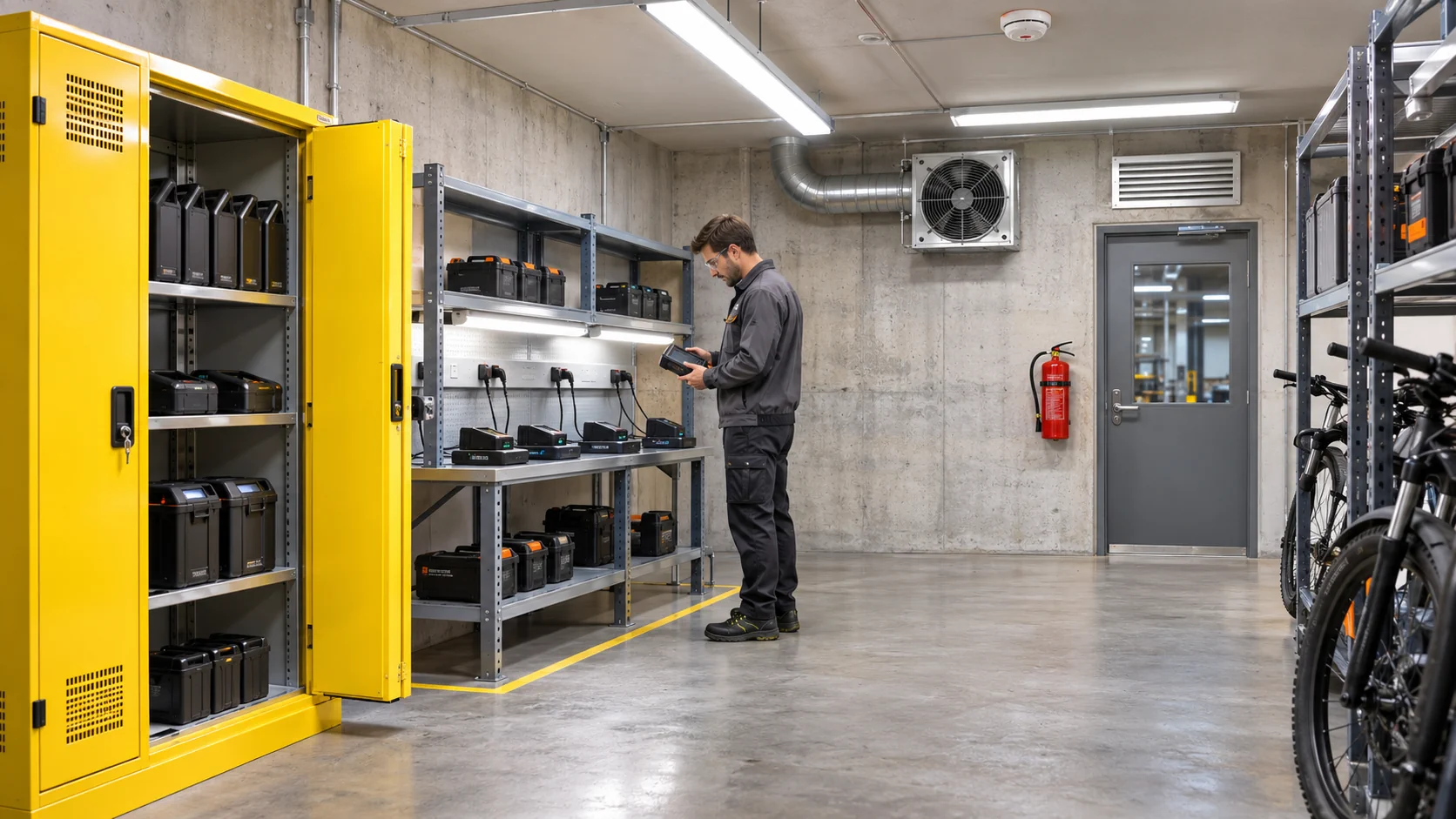
A specialised cabinet can be a relevant solution for certain companies: it helps organise storage or charging and may provide documented protection against certain fire scenarios. Its design and the tests it has undergone must nevertheless be examined carefully.
Is a lithium storage cabinet mandatory in the workplace?
There is no general obligation requiring the same cabinet in every Swiss company that has a lithium-ion battery. Requirements depend on the building, activity, identified risks and applicable provisions.
A small business using a few batteries for tools in good condition and a workshop containing dozens of bicycle batteries are not in the same situation. Before making any purchase, the employer must determine which risks need to be controlled and verify the necessary measures with the relevant specialists.
A cabinet can form part of a solution; it does not remove the need to inspect batteries, choose suitable chargers or organise the alarm response.
Storage cabinet or charging cabinet: what is the difference?
A storage cabinet houses batteries that are not connected. A cabinet intended for charging must also allow them to be connected electrically and manage the associated constraints: heating, cabling, charger ventilation and, where applicable, detection, alarm and disconnection.
An ordinary metal cabinet is not equivalent to specially tested equipment. Similarly, a model rated for resistance to an external fire does not necessarily demonstrate the same performance if thermal runaway begins inside it.
Before purchasing, ask the supplier about the intended use, capacity limits, test reports and installation instructions. Check that the tests genuinely correspond to the batteries and scenarios present at your facility.
EN 14470-1 and VDMA 24994 standards: what do they guarantee?
The EN 14470-1 standard has historically concerned safety cabinets intended for the storage of flammable liquids. Its scope must therefore not automatically be equated with a general certification of cabinets for lithium-ion batteries.
The technical specification VDMA 24994:2024-08 deals more directly with fire protection testing for cabinets for lithium-ion batteries, particularly when thermal runaway occurs. It provides useful information on the equipment’s behaviour in defined fire scenarios. VDMA 24994 concerns cabinets intended for removable lithium-ion batteries. Its test results must not automatically be applied to stationary energy storage installations.
However, neither reference should be interpreted as an absolute guarantee against toxic smoke, overpressure, all fires or all battery sizes. The exact scope of the tests remains decisive.
What criteria should be checked before buying a lithium battery cabinet?
Start with the type of batteries to be housed: chemistry, unit capacity, quantity, condition and whether or not they need to be charged. Then examine the cabinet’s actual characteristics: documented resistance, heat management, closure, any alarm, electrical connections, installation and maintenance.
Also ask practical questions: what happens if a battery develops a fault? Who receives the alert? Do the installations prevent a malfunctioning piece of equipment from being opened? Are the manufacturer’s instructions compatible with the selected room?
An expensive cabinet is not necessarily the most suitable. The right equipment is that whose demonstrated performance corresponds to the assessed risk and whose operation remains realistic for users.
| Criterion | Organised storage in a room | Specialised cabinet | Dedicated room |
|---|---|---|---|
| Needs addressed | Batteries in good condition, in limited quantities. | Storage or charging when the space does not allow satisfactory separation through organisation alone. | Large quantities, fleets, multiple charging. |
| Benefits | Simple and quick to implement. | Organisation of storage or charging; documented protection against certain fire scenarios. | Control of access and separation from other activities. |
| Points to check | Distance from combustibles, clear evacuation routes, stable supports, temperature. | Intended use, test reports, permitted capacities, alarm, connections, location outside evacuation routes. | Compartmentation, detection, ventilation, electrical installation, access for emergency services. |
| Limitations | Separation becomes insufficient if quantities or capacities increase. | No absolute guarantee; does not remove the need to inspect batteries or organise the alarm response. | Design must be studied with specialists; greater investment. |
No option is automatically the best: the choice follows from the inventory, battery condition and building constraints.
Ventilation, detection and fire protection for battery rooms
Technical protection measures must be designed as a whole. Detection without a usable alarm, a cabinet installed on an exit route or ventilation designed without considering the other measures may leave significant risks unresolved.
What ventilation is needed in a lithium-ion charging area?
During normal operation, chargers and batteries can release heat. Ventilation or air circulation must comply with the manufacturers’ recommendations and prevent heat from accumulating around the equipment.
In the event of a failure, a battery can rapidly release flammable, toxic and corrosive gases. Comfort ventilation is not sufficient to manage such an event.
The design of any safety ventilation, its interaction with compartmentation and smoke management must therefore be studied in situations where the risk warrants it, with competent specialists.
Smoke, heat and thermal monitoring detectors: what solutions are available?
Detection can make it possible to raise the alarm earlier: smoke detectors, temperature monitoring devices or other means selected according to the room. Each has limitations. A thermal camera, for example, can identify certain visible hot spots without detecting every internal fault.
Define who receives the alarm, how it is handled and what actions must follow. An installation without a response procedure or evacuation arrangements loses part of its value.
Choices must take account of occupants, operating hours and the building’s specific requirements. Remote monitoring does not remove the need for a suitable layout.
Fire compartments and automatic protection systems
A fire compartment is intended to limit the spread of fire for a defined period, according to the characteristics of its walls, openings and penetrations. Classifications such as EI 30 or EI 60 correspond to fire resistance performance under standardised conditions; on their own, they do not guarantee the absence of danger in a battery room.
Depending on the installation, fire detection, a sprinkler system or other means may help limit damage. Their effectiveness must be assessed against the possible scenarios, particularly thermal intensity, spread between batteries and ease of intervention.
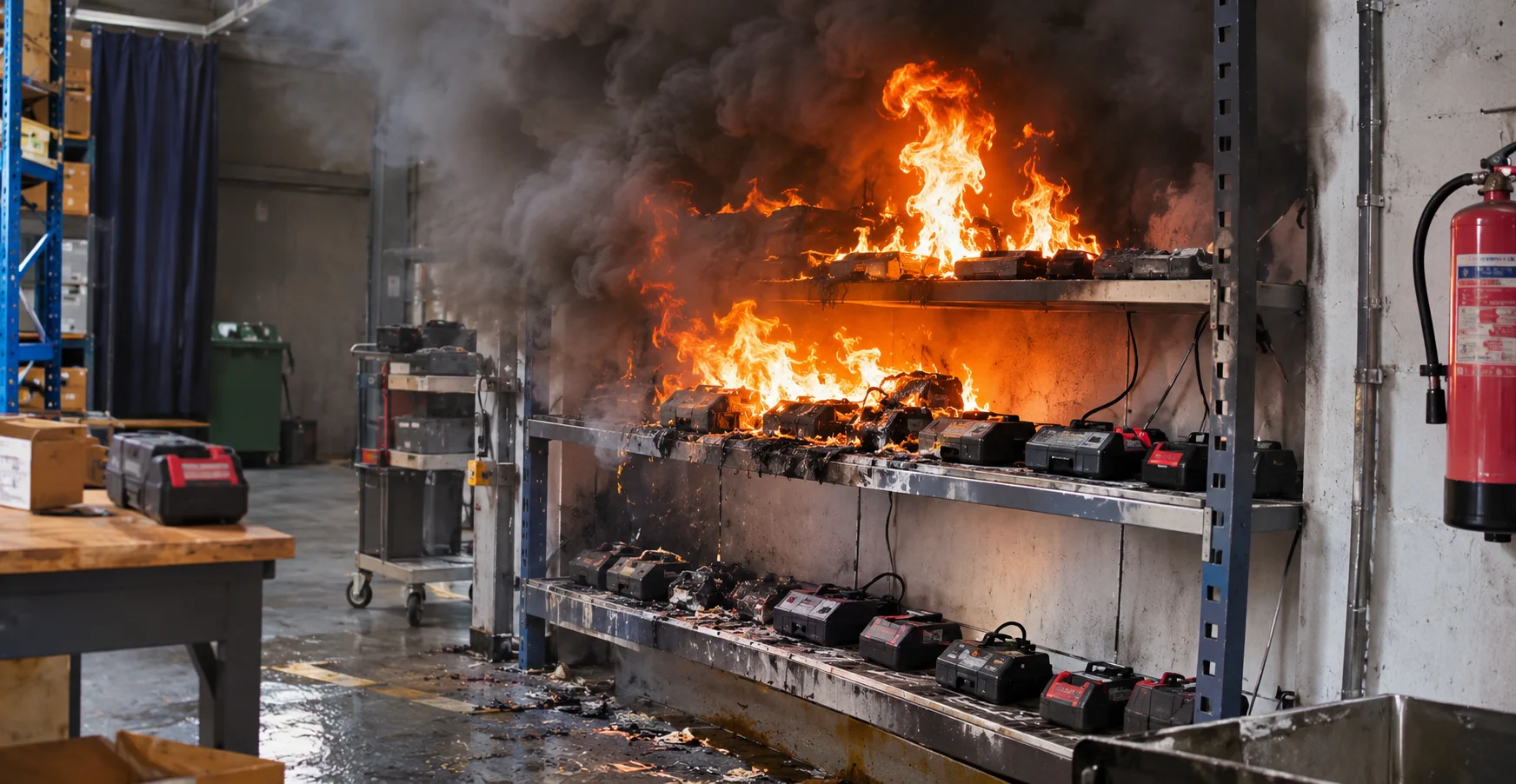
A system designed for a fire involving ordinary materials must not automatically be considered sufficient for significant lithium-ion battery storage.
Fire extinguishers and containment systems: what are their limitations when dealing with lithium batteries?
A battery undergoing thermal runaway may continue to release heat even after visible flames have disappeared. A conventional extinguisher therefore does not guarantee that the internal reaction will stop; a blanket or containment device may limit certain effects without eliminating all risks.
Prevention must first aim to prevent an incident, limit its spread and enable a rapid alarm. Technical measures must be consistent with procedures and the fire safety and evacuation audit when an in-depth site assessment is required.
An employee must never be asked to attempt to extinguish a significant battery fire without the appropriate skills and safe conditions.
Damaged lithium battery: how should it be stored and managed?
A suspect battery must not be returned to usable stock. It must be reported and managed according to a procedure appropriate to its condition.
Swollen, hot or deformed battery: recognising signs of failure
Possible signs include a swollen or cracked casing, deformation, leakage, a chemical odour, unusual heating or abnormal charging behaviour. A significant impact must also be reported, even when no damage is visible.
An anomaly does not systematically mean that a fire is imminent, but it justifies stopping use and charging until it has been checked. Employees must know how to report the situation without working on the cells themselves.
Why isolate suspect lithium batteries from normal stock?
To prevent accidental reuse and limit exposure of other equipment, it is appropriate to clearly identify suspect batteries and arrange for them to be managed separately from usable stock.
Here, the term “quarantine” refers to an appropriate procedure and location defined according to the battery’s condition and the risk assessment. This does not mean that anyone should be advised to transport a dangerous battery through a building.
Staff must distinguish between a suspect battery, which must be removed from service and assessed, and a battery undergoing active failure, which requires people to be placed in a safe location.
What precautions apply to a lithium battery in a critical condition?
If a battery releases gas, smokes, hisses or becomes dangerously hot, do not touch it or try to move it. Move away, warn people and evacuate the area. Call the fire service on 118 in Switzerland as soon as you are safe.
Do not open a cabinet in which a thermal event is taking place. Do not attempt to disconnect a charger either if doing so requires approaching the danger.
Damaged equipment presenting a high risk must be managed by competent people or service providers, following procedures suited to its condition.
| Battery condition | Signs | General response |
|---|---|---|
| Normal / no known anomaly | No damage or abnormal behaviour observed. | Storage and charging conditions according to the manufacturer, periodic checks. |
| Suspect / damaged | Impact, swelling, crack, leakage, odour, abnormal charging. | Stop use and charging, report it, have it assessed and do not mix it with normal stock. |
| Active failure | Smoke, gases, dangerous heating, hissing, flames. | Do not touch, evacuate and call 118. |
A suspect battery must be removed from service and assessed appropriately for its condition, without staff handling the cells. In the presence of smoke, gas, dangerous heating or other signs of serious failure, the priority is to move away, evacuate the area and alert the emergency services on 118. If there is any doubt about an immediate danger, prioritise keeping people safe.
Collection and transport of damaged lithium batteries in Switzerland
Used and defective batteries must not be mixed with ordinary waste. Their collection and transport may be subject to specific requirements for waste and dangerous goods, particularly in the case of damaged or unstable batteries.
The company must contact an appropriate collection channel and describe the condition of the batteries before removal. Packaging and transport requirements must be determined by the professionals responsible for the operation.
The INOBAT scheme provides information on Swiss take-back channels and has an emergency service in certain situations and for certain groups. Eligibility and conditions must be checked directly, as this service is not a general transport solution for all professional batteries.
Battery storage and charging: what precautions apply to different activities?
The relevant measures differ according to the profession, the quantities handled and the premises. Five professional contexts illustrate this diversity; three are based on a fictional example. These examples are intended to raise the right questions and do not define automatic compliance.
Offices and SMEs: securing everyday batteries and chargers
Situation: employees’ computers, phones, peripherals and electric bicycles are charged wherever a socket is available. Main risk: charging in passageways, damaged chargers and storage on unsuitable surfaces.
Initial measures: designate clear locations, inform employees and introduce a system for reporting anomalies. An industrial installation is not necessarily required, but the safety provisions applicable to the premises must still be observed.
Workshops and construction companies: batteries for cordless tools
Fictional example: a construction SME uses twelve batteries for drills and grinders. The chargers are spread across different workbenches, sometimes near cardboard or products used on construction sites.
Main risk: chargers scattered near combustible products and batteries returned from the worksite without inspection. Initial measures: group charging in a suitable location, check cables and batteries, keep combustibles at a safe distance, designate who reports damage and inspect every battery when it returns from the worksite, especially after a fall or impact.
A specialised cabinet should only be considered after this initial step.
Garages and electric bicycle repair shops: preventing fires
Fictional example: a workshop receives customers’ batteries, some of which come from accident-damaged bicycles. Their condition and history are not always known.
Main risk: receiving and sorting. A damaged battery can be dangerous even without obvious external damage, and employees must know this. Initial measures: ask about the circumstances of the incident, identify suspect batteries, do not recharge them before inspection and arrange for specialised handling.
Hotels, rental companies and electric bicycle fleets: setting up collective charging
Fictional example: a hotel offers twenty electric bicycles, each equipped with a 500 Wh battery, giving a nominal total of 10 kWh (see the inventory example). This total alone is not enough to choose the type of room or an HL class.
Main risk: the simultaneous charging of numerous batteries, possibly damaged during rental. Initial measures: examine the electrical installation and charging times, inspect batteries when they are returned, organise storage of replacement batteries and give instructions to staff. A dedicated charging room or specialised cabinet may be appropriate, but only a site assessment can determine the right choice.
Warehouses and logistics: managing the storage of large quantities of batteries
Main risk: in a warehouse, energy concentration, storage racks, spread between goods, structural resistance, sprinklers, handling and access for emergency services.
Initial measures: examine the actual characteristics of the storage units against the VKF provisions, which cover certain commercial and logistics storage configurations, without mechanically applying rules intended for small devices or stationary systems.
Swiss regulations: what rules apply to lithium battery storage?
In Switzerland, companies must take the necessary measures to protect workers and building occupants. However, the technical requirements applicable to batteries cannot be reduced to a single rule based on the number of units or the presence of a cabinet.
What are the employer’s obligations regarding fire safety?
The employer must organise accident prevention, identify relevant hazards and implement suitable measures. The Ordinance on the Prevention of Accidents (OPA), labour legislation and, where the conditions are met, the MSST approach are important points of reference.
At building level, VKF fire protection regulations and their cantonal application govern, among other things, evacuation routes, organisation and protective installations. The precise requirements depend on the use, construction and risks.
For a broader overview, SafetyFirst presents the fire safety obligations of companies in Switzerland. Battery-specific recommendations must be interpreted within this general framework and do not replace decisions by the competent authorities.
VKF Guide 2005-15: recommendations for lithium-ion batteries
The VKF Guide 2005-15 on lithium-ion batteries, in its version dated 1st August 2022, provides proposed solutions for different situations: warehouses, stationary energy storage installations, collection points, charging stations and certain vehicle categories.
The document sets out protection objectives and possible measures. It states that assessments and solutions should be regarded as general guidance to be adapted to the project. It is not an identical obligation imposed on every owner of a small rechargeable device.
A company must examine the provisions corresponding to its activity and, where necessary, confirm them with a fire safety specialist and the competent authorities.
HL I, HL II and HL III classification: understanding risk levels
The VKF Guide uses three risk levels (Hazard Level, HL): I, II and III. The thresholds vary according to the category concerned. The following values are taken from the table in chapter 3.2 and must be read only within their scope of application.
Different fields of application depending on the column. These thresholds must not be compared with one another and do not apply as such to a bicycle fleet or tools.
| Criterion | Commercial warehouses: energy per m³ of storage unit | Stationary storage: energy per fire compartment | Vehicles: energy per vehicle |
|---|---|---|---|
| HL I — low | Less than 1 kWh/m³ | Less than 15 kWh | Less than 1 kWh |
| HL II — medium | From 1 to 50 kWh/m³ | From 15 to 100 kWh | From 1 to 50 kWh |
| HL III — high | More than 50 kWh/m³ | More than 100 kWh | More than 50 kWh |
Warning: the thresholds for a warehouse, a stationary installation and a vehicle are not interchangeable. A nominal total of 10 kWh (inventory example) is not enough to classify a facility as HL I or HL II. The characteristics of the actual configuration and the applicable chapters must be examined.
LFP batteries: what VKF recommendations have applied since September 2025?
LFP batteries (lithium iron phosphate or LiFePO4) belong to the lithium-ion family. They generally offer good thermal stability compared with certain other chemistries, but their use is not risk-free.
In September 2025, VKF published an interpretation concerning stationary LFP storage systems in buildings. It highlights, among other things, the importance of the manufacturer’s requirements, the exclusion of evacuation routes and areas exposed to a fire or explosion hazard, and the consideration of compartmentation and ventilation.
For the relevant indoor stationary systems, this interpretation proposes compartments of at least EI 30 up to 100 kWh, and EI 60 from 100 kWh, subject to the resistance rating required by the use of the building. As the 100 kWh limit is expressed in both categories of the FAQ, no independent conclusion should be drawn for a borderline case without technical verification.
This text must be clearly distinguished from removable bicycle or tool batteries: its proposals explicitly concern stationary LFP systems.
New Swiss fire safety regulations: what developments should be expected?
As of the date this guide was written in November 2026, the 2015 edition of the VKF regulations still constitutes the framework currently being applied. Their revision is the subject of ongoing work and communications in preparation for new regulations.
The announced schedules have evolved. For every installation, it is therefore necessary to check the officially confirmed effective date and any transitional provisions, rather than treating a project as already subject to mandatory requirements.
A professional guide must be updated when applicable requirements change. The references in this article correspond to the texts consulted in November 2026.
ECA Vaud support: funding a storage or charging cabinet
For certain installations located in the canton of Vaud, the purchase and installation of a specialised cabinet may qualify for financial support. This is a conditional grant, not an automatically acquired subsidy.
Which companies can benefit from ECA Vaud support?
The programme of the Cantonal Insurance Establishment of the canton of Vaud concerns certain storage and/or charging cabinets for batteries, as well as eligible costs required for their installation. The equipment must correspond to a prevention measure proportionate to the area being protected.
The conditions are cumulative. Depending on the programme terms, the selected model must in particular comply with the EN 14470-1 standard and/or the VDMA 24994:2024-08 technical specification. The installation must comply with the manufacturer’s requirements and the restrictions applicable to the building; in particular, a cabinet must not be installed on an evacuation route.
The batteries themselves are not subsidised under this scheme.
What amounts and equipment have been subsidised since June 2026?
ECA Vaud announces a contribution of 80% of eligible costs, capped at CHF 10,000 per application. In principle, only one contribution may be granted per household, operator or building.
The programme runs from 1st June 2026 to 31 May 2029, subject to the availability of funds. Invoices dated before 1st June 2026 are not covered retroactively.
These figures are those published at the time of writing. They do not constitute confirmation of eligibility for a particular project.
How can you apply for financial support for a lithium battery cabinet?
According to the published procedure, the application is submitted after installation. The application must include the required form, photographs proving completion, the detailed invoice and proof of payment.
Before making any purchase, it is advisable to check the latest version of the ECA Vaud grant conditions for battery cabinets. The programme also provides for specific restrictions for certain locations, particularly underground car parks.
How should battery fire prevention be organised in the workplace?
A technical solution will only be effective if users understand it and the organisation knows how to respond when equipment becomes suspect. Prevention must therefore combine written rules, training, checks and emergency preparedness.
Introducing an internal storage and charging procedure
A simple procedure can specify where batteries are stored, who may charge them, which chargers are authorised and how to report an anomaly. It must also establish who may decide to remove a battery from service and whom to contact for its inspection or disposal.
Contractors and visitors must be taken into account when they bring electrical equipment or use charging areas. A responsible person must be able to check periodically that the planned arrangements correspond to actual practices.
Keep this document short enough to be useful in the field.
Points that an internal procedure must settle
- Where?The authorised locations for storage and charging.
- Who charges?Authorised people and approved chargers.
- Who reports?How to report an anomaly without working on the cells.
- Who removes it?The person who decides to remove a battery from service.
- Who checks it?The service provider or specialist responsible for inspection and disposal.
- Who verifies?The person responsible for periodically comparing the rules with actual practices.
Training employees on lithium-ion battery risks
Users must recognise a battery that is abnormally hot, swollen or damaged, know how to stop using it and understand the limits of their intervention. They must understand that the disappearance of flames does not necessarily mean that all danger has gone.
Awareness training can be incorporated into a workplace fire prevention course when the programme is adapted to the context and equipment present. However, it must not be assumed that standard fire extinguisher training alone prepares someone to intervene in a significant thermal runaway event.
Regularly checking batteries, chargers and storage areas
Plan checks proportionate to use: the condition of casings, cables and connectors, cleanliness of areas, absence of unsuitable combustibles, clear passageways and the actual presence of instructions.
Incidents and near misses must be recorded. Lessons learned will make it possible to correct the organisation, review installations or amend usage rules when necessary.
The frequency of checks must take account of the equipment, manufacturers’ recommendations and site characteristics; there is no universal interval to copy for every company.
Fire breaking out in a charging area: what emergency instructions apply?
When faced with a battery that is smoking, releasing gas or on fire, the priority is to move away, warn others, evacuate and call the fire service on 118 in Switzerland. A dangerously hot or smoking battery must not be moved. Do not open a cabinet involved in a thermal incident to try to check its condition.
The company must have an evacuation arrangement suited to the premises: clear access routes, identified responsibilities, people to notify and useful information to pass on to the emergency services. A workplace evacuation plan helps clarify these points when its presence and content are suited to the building’s requirements.
People responsible for directing occupants must know their responsibilities. Building evacuation training can help prepare this organisation and test it under site-specific conditions.
Checklist: does your company store its lithium batteries safely?
This list is a starting-point self-assessment, not a certificate of compliance. A negative or uncertain answer calls for a check suited to the actual risk.
Self-assessment: 14 questions
- Have we identified the batteries present and their locations?
- Do we know their capacity and the associated charger models?
- Do evacuation routes remain free of all storage and connections?
- Are the batteries kept away from combustible materials according to the relevant measures?
- Are the chargers compatible, identified and in good condition?
- Is the electrical installation suitable for simultaneous charging?
- Are the batteries positioned stably and protected against impacts?
- Are the manufacturer’s temperature and cooling conditions respected?
- Is there a clear instruction for suspect or damaged batteries?
- Are batteries showing an anomaly prevented from being charged again?
- Are detection and alarm systems suited to the risks and operating hours of the site?
- Do employees know whom to notify and how to respond in the event of smoke?
- Are evacuation procedures known and exits accessible?
- Are the areas, equipment and procedures checked and reviewed regularly?
The boxes are for reference only: nothing is recorded or transmitted, and checking all the boxes does not constitute a certificate of compliance.
Frequently asked questions about lithium battery storage and charging
Can lithium-ion batteries be charged in an office?
It depends on the battery, its charger, the room, nearby materials and evacuation routes. A dedicated and organised area is preferable to scattered charging, especially for electric mobility batteries.
Is a separate room always required to charge batteries?
Not in every situation. Depending on the quantity, capacity and applicable provisions, a suitable location and proportionate measures may be sufficient; other configurations require a separate compartment or a specially designed cabinet (see Where to store batteries).
How many lithium batteries can be stored in the same room?
There is no universal number: the assessment covers energy capacity, arrangement, battery condition and the building. VKF HL classes are not all based on the same unit (see the HL classification).
Can several electric bicycle batteries be charged simultaneously?
This is possible in installations designed and organised for this purpose, with compatible chargers, correctly sized electrical infrastructure and suitable prevention measures. Multiple charging configurations must be examined more carefully, particularly when the fleet is large or charging continues when staff are absent.
What safety distance should be maintained around a battery being charged?
The VKF Guide proposes 2.5 m from combustible materials for certain charging stations for small vehicles and multiple commercial installations (chapters 4.8 and 4.9). This is not a general rule for every device or room; see the section on distances.
Is a metal cabinet sufficient for storing lithium batteries?
Not necessarily. An ordinary metal cabinet does not demonstrate the performance of a model tested for batteries, particularly in the event of internal thermal runaway. Check the tests, intended use and permitted capacities (see choosing a cabinet).
Does an LFP battery require the same precautions as an NMC battery?
Different lithium-ion chemistries do not behave in exactly the same way thermally, but none is risk-free. The rules must take account of the manufacturer, application and installation. The September 2025 VKF interpretation concerning stationary LFP systems must not automatically be applied to removable batteries.
Who can check the safety of a charging area in Switzerland?
Depending on the nature of the project, different specialists may be involved: electrical installation professional, SST/MSST manager, fire safety specialist, quality assurance manager or competent authority. An assessment must cover the site’s risks rather than being limited to checking a cabinet or charger.
Conclusion — Securing battery storage and charging for the long term
To secure lithium-ion battery storage and charging, start by creating an inventory of your equipment and examining the actual conditions in which it is used. You can then define suitable locations, charging rules, checks and the necessary protective measures.
When the quantities, capacities or building layout warrant it, have the risks assessed and the applicable requirements checked before undertaking any work.