Where to Place a Defibrillator in a Workplace?
30/07/2026
Practical guide Fire prevention
Lithium-ion batteries power many everyday objects today: smartphones, computers, power tools, scooters, bicycles and electric cars. They make it possible to store a large amount of energy in a small volume. However, a damaged, misused or defective battery can present a specific fire risk.
A lithium-ion battery can catch fire following an impact, short circuit, overheating or charging fault. In certain circumstances, these failures cause a phenomenon known as thermal runaway, which can lead to the release of gas, toxic fumes, ejected particles and a fire that is difficult to control.
Should you be concerned about every battery? How can you recognise the first signs of danger? Can you charge your electric bicycle overnight? Here is the essential information for understanding the risks and adopting the right actions, at home and at work, based on the guidance applicable in Switzerland.
Guide contents
Why can a lithium-ion battery catch fire?
A lithium-ion battery stores and releases energy through electrochemical reactions. It contains electrodes, an electrolyte and a separator designed to prevent direct contact between them. This technology combines light weight, autonomy and high energy density.
This concentration of energy also explains why an internal failure can release a large amount of heat in a short time. The risk depends on many factors: the battery’s composition, manufacturing quality, capacity, condition, use and environment.
What is battery thermal runaway?
Thermal runaway, or thermal runaway, is an uncontrolled reaction in which a cell heats up as a result of internal reactions that themselves generate more heat. The higher the temperature rises, the more quickly certain reactions may accelerate.
In a pack made up of several cells, heat can reach neighbouring cells. The phenomenon may then spread. Depending on the situation, it can produce gas, smoke, flames, ejected particles or a major fire.
Thermal runaway does not occur after every impact or every anomaly. However, once it begins, its development can be rapid and difficult to predict.
Thermal runaway in 4 stages (simplified diagram)
- Fault or damageA cell is subjected to stress or failure.
- Internal heatingReactions may generate increasing amounts of heat.
- Possible propagationNeighbouring cells are exposed.
- Emissions / fireGas, smoke, flames or ejected particles may appear.
Short circuit, overcharging and impact: the main causes of fire
Several causes can weaken a lithium-ion battery:
- Mechanical damage: a fall, crushing, puncture or severe impact that may damage internal components.
- Electrical faults: short circuit, overcharging or an unsuitable charger.
- Excessive temperature: prolonged exposure to a heat source, sunlight or conditions exceeding the intended limits.
- Progressive degradation: ageing, manufacturing defect, corrosion, moisture or improper repair.
- Improper use: modifying a battery pack, replacing cells or charging a deeply discharged battery without appropriate checks.
Many modern batteries have an electronic battery management system (BMS) that monitors temperature, voltage and charge. It helps reduce certain risks but does not guarantee the complete absence of failure.
Can a lithium battery catch fire without being charged?
Yes. Charging requires particular vigilance, but a battery can also fail during use or storage. An impact can cause invisible internal damage whose consequences only appear later, sometimes after several hours or days.
A battery that still appears to work after an accident is therefore not necessarily intact (what to do: see the warning signs).
Do all lithium-ion batteries present the same risks?
No. Lithium-ion batteries encompass several chemical compositions. NMC technologies, for example, are used in some electric vehicles; LFP batteries (lithium iron phosphate) generally offer greater thermal stability under certain conditions. However, none of these chemistries is entirely free of danger.
Rechargeable lithium-ion batteries must also be distinguished from lithium-metal batteries, which use a different technology and do not react in exactly the same way during an incident.
What are the dangers of a lithium-ion battery fire?
In addition to flames, a battery fire presents other dangers: rapid heat propagation, gas and smoke, ejected particles and the risk of reignition after extinguishment.
Why can battery fires spread so quickly?
In a cell assembly, the heat produced by a failing cell can reach the others. Propagation depends on the pack’s design, its condition and the environment.
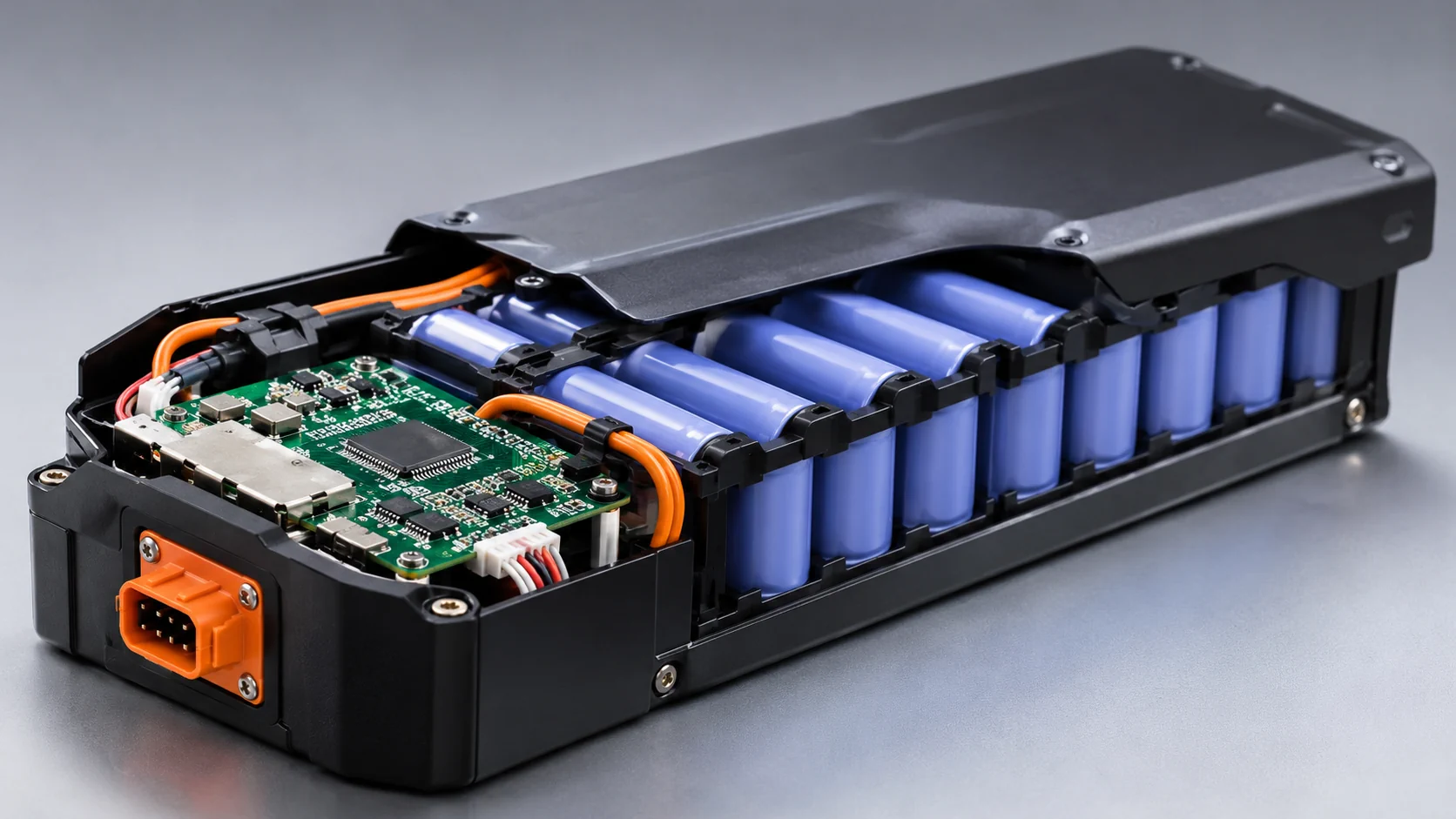
The possible consequences are not the same for a phone battery of a few dozen Wh, an electric bicycle battery of several hundred Wh or a vehicle battery of several dozen kWh. Capacity alone cannot, however, be used to calculate the probability of fire.
The environment plays a decisive role: textiles, cardboard, combustible materials or obstructed evacuation routes can worsen the situation and endanger people.
Toxic fumes from lithium batteries: what are the health risks?
A battery undergoing thermal failure can release irritating, flammable, toxic or corrosive substances. Depending on its composition and the conditions of the fire, emissions may include carbon monoxide, organic compounds and, in some cases, hydrogen fluoride.
These fumes can cause irritation and serious respiratory harm. In an enclosed space, certain flammable gases can also accumulate and create an additional danger.
Do not try to smell or identify fumes by approaching them. Move away from the area, avoid inhalation and alert the emergency services. After exposure, move to an open-air location and seek medical assistance; in Switzerland, the medical emergency number is 144.
Can a lithium-ion battery explode?
A failure can rapidly release gas and increase the pressure inside a cell or casing. This can cause a violent rupture, ejected particles or the sudden ignition of gas. In an enclosed space, an accumulation of flammable gases can also create an explosion risk.
Not every incident causes an explosion. However, this danger means keeping your distance and never opening or puncturing a battery that is abnormally hot, swollen or smoking.
How can you recognise a damaged or dangerous lithium battery?
Before an incident, certain signs may reveal a fault or deterioration. They deserve particular attention, especially after a fall or unusual charging.
Swollen, abnormally hot or deformed battery: warning signs
Pay particular attention to:
- Swelling or deformation: bulging, cracked or deformed casing.
- Abnormal heat: a battery that is excessively hot during charging, use or while idle. Dangerous heating is an emergency.
- Unusual smell: a chemical, solvent or burning smell.
- Hissing and crackling: abnormal sounds associated with gas release, a sign of dangerous failure.
- Leak or deterioration: suspicious traces of moisture, impact, puncture or corrosion.
- Abnormal behaviour: charging interruptions, reduced battery life or repeated malfunctions. This sign alone calls for inspection, not evacuation.
- SwellingBulging or cracked casing, or a casing that no longer closes.
- Unusual heatHotter than usual, even while idle.
- Chemical smellSolvent, plastic or burning smell.
- HissingHissing, sizzling or crackling.
- Leak or deformationSuspicious trace, impact, puncture or corrosion.
- Abnormal chargingCharging interrupted, battery life dropping.
Swelling, deformation, leakage or abnormal operation justify stopping use and arranging a professional inspection. Smoke, gas, hissing or dangerous heating indicate a dangerous failure: move away and alert the emergency services (see below). The absence of visible signs does not guarantee that an accident-damaged battery is safe: after a serious impact, have it checked before reusing or recharging it.
What should you do when a battery shows signs of failure?
A swollen or deformed battery, or one showing abnormal operation, must be taken out of service. Do not recharge it and seek advice from the manufacturer or a qualified professional. Do not attempt to open it, straighten it or replace cells yourself.
If it releases smoke or gas, becomes dangerously hot or emits alarming sounds associated with a failure, do not attempt to handle it. Move away, evacuate exposed people and alert the fire service by calling 118 in Switzerland.
How can you charge a lithium-ion battery safely?
To charge a lithium-ion battery, use a compatible charger, check its condition and choose a suitable location. These precautions are particularly important for bicycle, scooter and professional-equipment batteries.
Which charger should you use to prevent a fire from starting?
Use a charger that is compatible with and recommended by the manufacturer. An unsuitable model may apply incorrect electrical parameters or fail to work properly with the battery’s protection systems.
Regularly check cables, plugs and connectors. Do not use a damaged charger or cable. Avoid modified batteries, improvised adapters and accessories with insufficient traceability.
Can you leave a lithium battery charging overnight?
For electric bicycle and scooter batteries, it is prudent to avoid charging while asleep or away from home. In the event of a failure, an awake person can detect a warning sign more quickly and leave the premises.
The Swiss Fire Prevention Advisory Centre (CIPI) recommendations specifically advise against charging overnight or when occupants are absent. Once charging is complete, disconnect the battery and charger in accordance with the manufacturer’s instructions.
Where should you charge a battery to limit fire risks?
Choose a stable location suitable for charging, fire-resistant and away from combustible materials. Avoid charging a battery on a bed, sofa or carpet, or near cardboard and clothing.
Do not charge in an evacuation route, such as a corridor, staircase or in front of an entrance door. A fire starting there could block the occupants’ exit. Suitable smoke detection in the room can improve early warning, but does not replace prevention measures.
Temperature, humidity and cold batteries: what precautions should you take?
Observe the manufacturer’s temperature ranges and charging conditions. A very cold battery after being outdoors should generally return to a suitable temperature before charging. A battery that has become very hot during use must be allowed to cool.
Also protect equipment from moisture, frost, intense heat and direct sunlight. The exact permitted temperatures vary by model: do not apply a single threshold to all batteries.
Safe storage of lithium batteries: what are the best practices?
Even when not in use, batteries store energy. Store them in a dry, temperate place protected from impacts and away from combustible materials.
Where should lithium-ion batteries be stored at home or at work?
Avoid direct sunlight, heat sources, moisture and frost.
Protect exposed electrical contacts against short circuits and avoid accumulating batteries in an unsuitable space. At work, the number, capacity and condition of the batteries should guide storage measures.
How should you store a lithium battery for several months?
For long-term storage, a partial charge is often preferable to a completely discharged battery. A charge level of around 40 to 60% is frequently recommended, subject to the manufacturer’s specific instructions.
Periodically check the battery’s condition and charge level to prevent deep discharge. When recommended by the manufacturer, remove the battery from the device during a long period of non-use.
Safety cabinets and fire-resistant containers: what protection do they provide?
Specialised cabinets, boxes and fire-resistant bags are available. They can help compartmentalise or limit certain effects of an incident. Their effectiveness depends on their design and the corresponding tests: an ordinary metal cabinet or a simple bag advertised as “fire-resistant” does not guarantee control of thermal runaway.
For professional sites that store or charge numerous batteries, the choice of equipment should result from a risk assessment and consideration of the building’s constraints.
Do
- Choose a dry, temperate location.
- Protect terminals against short circuits.
- Check the battery after an impact.
- Observe the storage charge indicated by the manufacturer.
Avoid
- Direct sunlight or heat sources.
- Frost or moisture.
- Piles of batteries near combustible materials.
- Mixing a damaged battery with the others.
Electric scooter and bicycle fires: how can you prevent the risks?
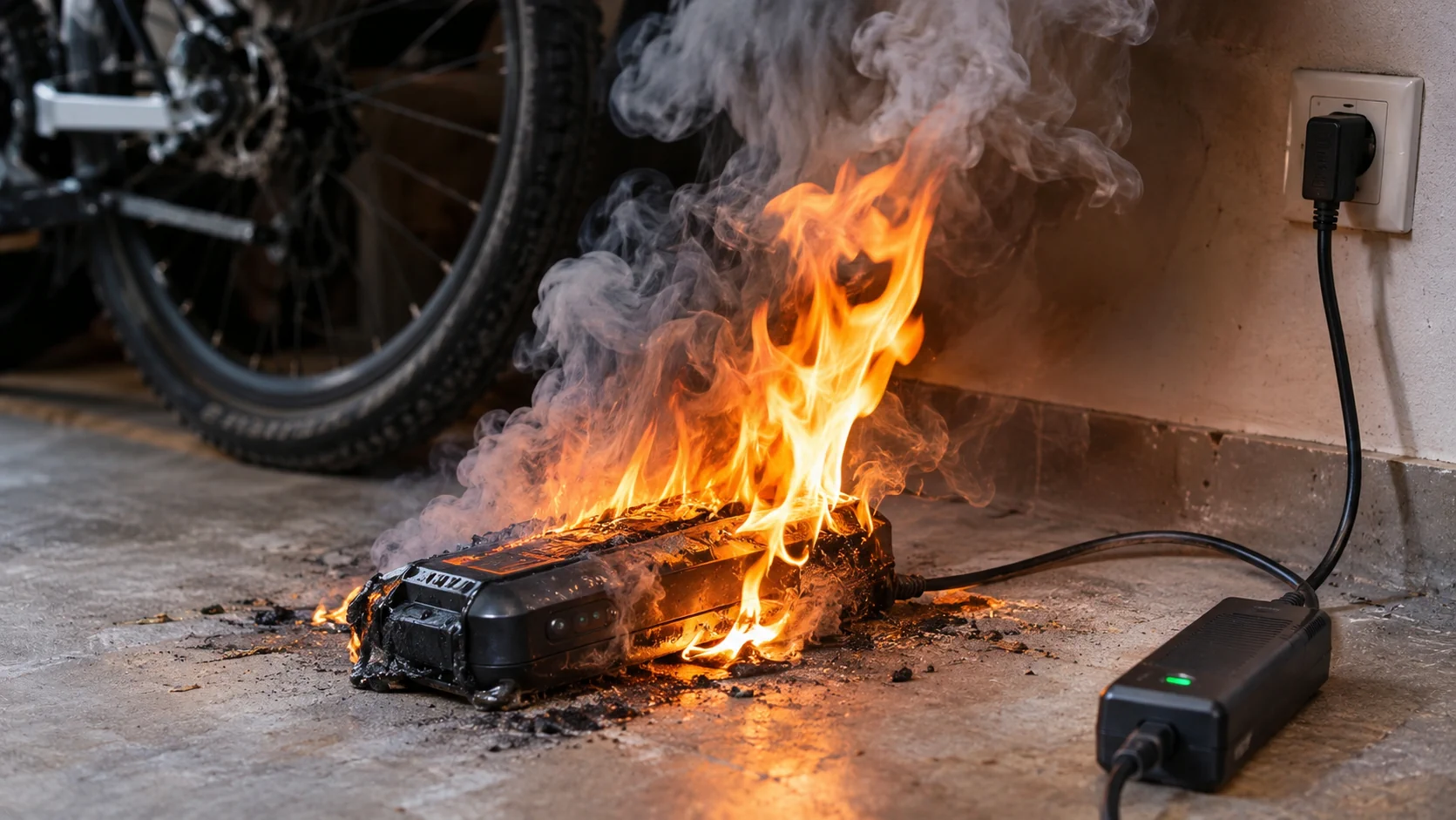
Light electric mobility batteries are regularly transported, subjected to vibration and sometimes exposed to falls. They are also charged in homes, garages and shared premises, where the environment can worsen the consequences of an incident.
Why can an electric scooter battery catch fire?
As with other lithium-ion batteries, possible causes include an impact, short circuit, overheating or a charging fault. Power modifications, improper repairs and incompatible replacement batteries can increase certain risks.
A second-hand vehicle with an unknown history deserves particular attention, especially if its battery has been replaced or modified.
How can you charge an electric bicycle or scooter safely?
The general rules (compatible charger, location and supervision) are set out in Safe charging. For an electric bicycle or scooter, do not block the exit from the home or building either.
In a garage or bicycle room, it may be necessary to define charging locations, move combustibles away and establish shared instructions for users.
Electric bicycle battery after a fall: what should you check?
After a fall, look for cracks, deformation, impact marks and damaged connectors without opening the casing. If in doubt, a specialist inspection must take place before any charging, since internal damage may not be visible.
Bicycle rooms, condominiums and professional fleets: what precautions should you take?
In a hotel, condominium, delivery company or bicycle fleet, safety also depends on collective organisation: charging locations, access to exits, detection, regular inspection and a procedure for removing damaged batteries.
Suspect batteries must not be put back among equipment in good condition without appropriate precautions. Clear organisation also makes it possible to know whom to notify of a fault and how to respond in the event of an alert.
| Use | Indicative battery range | Particular vigilance |
|---|---|---|
| Phone / computer | A few dozen Wh | Impact, accessories and charging on textiles. |
| Electric bicycle / scooter | A few hundred Wh to ~1 kWh depending on the model | Falls, charging room and modified batteries. |
| Electric car | Several dozen kWh | Charging installation, battery after an accident and specialist intervention. |
Capacities vary by model and are purely indicative: they cannot be used to infer an automatic ranking of fire probability.
Electric car fires: what are the actual risks?
A fire involving an electric car’s high-voltage battery may require complex intervention, particularly because of cooling difficulties and the risk of reignition. This does not mean that electric cars catch fire more often.
Do electric cars catch fire more often than combustion-engine vehicles?
Available comparisons do not establish that electric cars systematically catch fire more often than combustion-engine models. National statistics depend on the country, year and scope of the vehicles included.
Comparing raw numbers of fires makes no sense without considering the size and composition of the vehicle fleet (vehicle age and powertrains) and the counting method. Moreover, a fire involving an electric car is not necessarily started by its battery.
Electric car battery fire: why is intervention complex?
A traction battery contains numerous cells, often in a compartment that is difficult to access. When thermal runaway occurs, cooling and preventing reignition may require specialised resources and monitoring.
The presence of high voltage is an additional constraint. Any intervention involving an accident-damaged electric car or one whose battery is burning must be left to qualified emergency services.
Charging stations, garages and underground car parks: how can risks be reduced?
Charging must rely on an electrical installation sized appropriately and compliant with the applicable requirements. Ordinary power strips and extension leads are not a suitable solution for prolonged, repeated charging.
In shared garages and underground car parks, prevention also takes alarms, evacuation, smoke management and responder access into account. Measures depend on the building’s configuration and the applicable requirements.
Which fire extinguisher or fire blanket should be used for a lithium-ion battery?
A distinction must be made between extinguishing visible flames, cooling the cells and limiting propagation.
Can you extinguish a lithium battery fire with water?
Water can help cool the cells of a lithium-ion battery. However, its use depends on the size of the battery, the stage of the fire and the electrical risks.
The Swiss Fire Prevention Advisory Centre (CIPI) states that a small, contained fire involving a small device, such as a smartphone or laptop, may possibly be tackled with a large amount of water, but only if this can be done safely.
This possibility must never lead anyone to approach a smoking battery, handle dangerous equipment or delay evacuation. For bicycle, scooter and electric vehicle batteries, the fire service must be allowed to intervene.
In the event of smoke, gas or fire spread, move away, evacuate and call 118.
Lithium battery fire extinguisher: what are the limitations of conventional models?
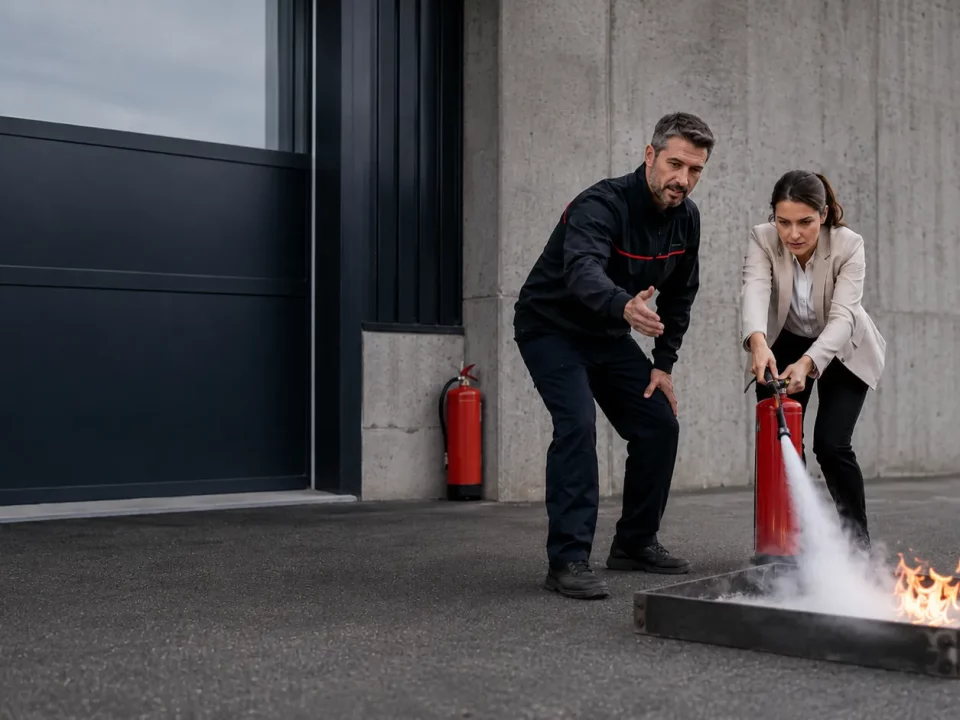
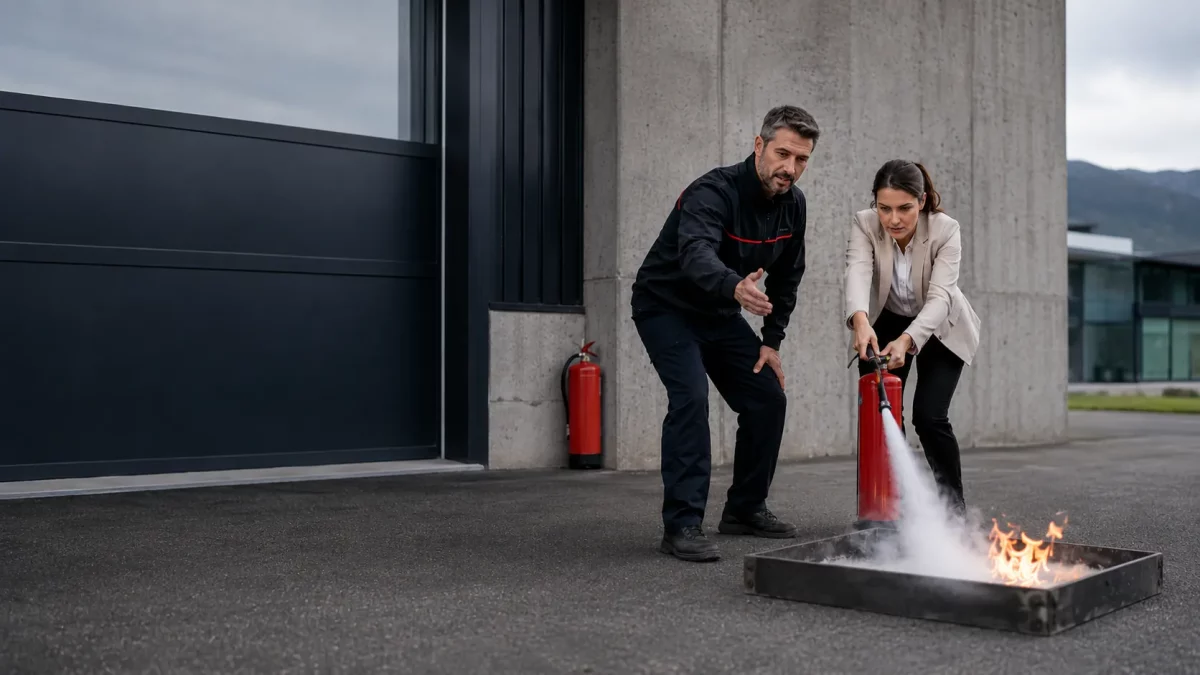
Powder, CO₂ and water extinguishers have defined areas of use. Some may act on materials burning around a battery without necessarily stopping its internal reactions. Our practical guide also explains how to use a fire extinguisher effectively on fires for which it is intended.
Special agents and devices are available for certain uses, but their performance must be supported by tests appropriate to the type and capacity of the batteries concerned.
To understand the conventional fire classes, see our article on the classification of different fire types and how to extinguish them. Fire extinguisher training also teaches participants to recognise the limitations of available equipment and avoid unnecessary exposure.
Lithium fire blanket: extinguishing, containment or limiting propagation?
Fire blankets are not all designed for the same uses. Some are intended for small devices, while others are intended for two-wheelers or vehicles.
Depending on their design, they may help reduce certain flames or limit spread to the surrounding environment. They do not guarantee that thermal runaway will stop, and using them on an active fire can expose the user to significant dangers. Complex interventions are the responsibility of professionals.
Fire class L: what the classification of lithium-ion battery fires changes
The international standard ISO 3941:2026 introduces class L to identify lithium-ion battery fires specifically. It distinguishes them in particular from class D metal fires.
This classification does not mean that a fire extinguisher simply labelled “lithium” is automatically suitable for all batteries. Equipment performance must be supported by tests corresponding to the batteries and fire scenarios concerned.
The ISO 3941 international classification must also be distinguished from the European standards applicable to fire extinguishers, particularly EN 2, whose developments must be checked separately (see also the ANPI presentation of class L).
| Solution | Potential role | Key limitation |
|---|---|---|
| Conventional fire extinguisher | May act on surrounding materials depending on its intended class of use. | Does not guarantee that thermal runaway will stop. |
| Fire blanket designed for the intended use | May help limit certain flames / propagation. | Does not necessarily cool the cells; performance varies. |
| Water cooling by emergency services | May lower the temperature and limit propagation. | Intervention requiring expertise, a quantity of water and consideration of electrical risks. |
| Specialised solutions | Protection or containment within a defined framework. | Effectiveness must be verified through tests suited to the type and capacity of the batteries. |
There is no universal solution.
Lithium battery smoking or on fire: how should you react?
A failure can develop rapidly. The priority is never to save the equipment: people must be protected and the emergency services alerted.
First actions when a battery fire starts
- Move away immediately from the smoking, hissing or burning battery; do not handle it.
- Warn people present and evacuate via a safe route.
- Call the fire service on 118 in Switzerland once you are safe.
- Close the doors as you leave if this can be done without delay or exposure to danger.
- Do not re-enter the premises until authorised by the emergency services.
Do not attempt to unplug a charger if doing so requires you to approach a dangerous battery. Cutting off the power should only be considered if it can be done from a distance and without risk.
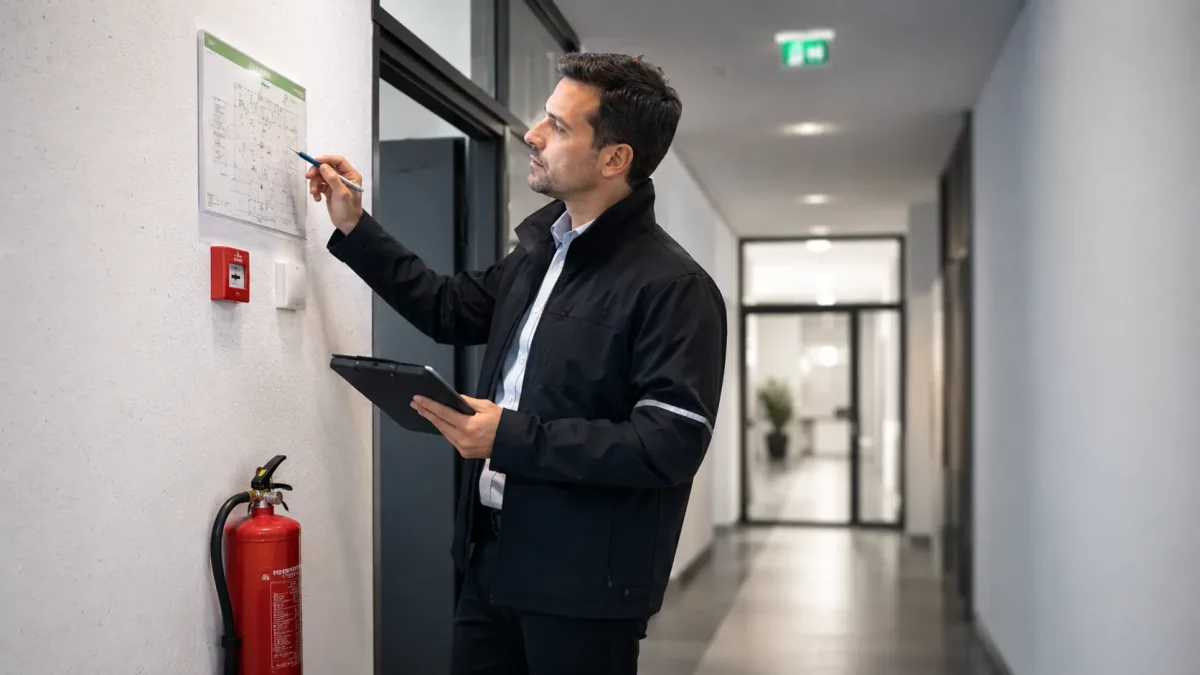
In the workplace, a workplace evacuation plan helps clarify routes, responsibilities and instructions. The common mistakes made during a workplace fire also show why these actions must be prepared in advance.
Fire involving a smartphone, scooter or car: are the reactions different?
The risks depend on the size and configuration of the battery: an instruction that is valid for a very small device does not apply to a bicycle or car battery (see water and extinguishing).
For larger batteries, particularly those in bicycles, scooters or electric vehicles, do not attempt to extinguish the fire yourself. Evacuate, move other people away and alert the fire service.
Why can a battery catch fire again after being extinguished?
Some cells may remain hot or continue to deteriorate after the flames have disappeared. A new internal reaction can then cause the fire to reignite.
A battery involved in thermal runaway must therefore be handled and monitored by competent responders. The absence of visible flames is not a guarantee of safety.
Preventing lithium-ion battery fires at work: what measures apply in Switzerland?
Businesses are using more and more batteries: computers, rechargeable tools, logistics equipment, delivery bicycles, vehicles and energy-storage systems. These uses may be combined in the same building.
Begin by identifying the equipment present and its conditions of use: the same solution is not suitable for every installation.
How should battery-related risks be assessed in the workplace?
An initial assessment can identify:
- the number and type of batteries;
- their capacities and locations;
- charging, storage and maintenance conditions;
- the proximity of combustible materials;
- the condition of the equipment and procedures in the event of damage;
- warning systems, exits and evacuation arrangements.
This process forms part of a broader occupational risk assessment. An initial occupational health and safety audit (MSST) analyses the organisation of prevention across the site.
For emergency preparedness and the organisation of premises, a fire and evacuation safety audit can help identify weaknesses in procedures, evacuation routes and existing systems. These services do not constitute specialised certification for lithium-ion batteries.
Lithium battery charging area: what protection should be provided?
A professional charging area must take into account electrical constraints, separation from combustible materials, detection and the organisation of emergency response, according to the batteries actually used, their total energy and the building.
Depending on the applicable risks and requirements, a dedicated location, compartmentation or suitable storage equipment may also be added.
Also provide a procedure for taking suspect batteries out of service and visible instructions. For the complete method (inventory, design of the charging area and cabinet selection), see our guide to storing and charging lithium-ion batteries at work.
Lithium-ion fire safety: what do AEAI and Swiss organisations recommend?
In Switzerland, the AEAI fire protection regulations constitute an important reference framework. The requirements to be applied vary according to the building’s use, configuration and installations, as well as decisions by the competent authorities. Our article on legal fire safety obligations in Switzerland presents the main principles.
The AEAI 2005-15 guide on lithium-ion batteries presents recommendations for different uses, particularly storage and certain installations. These recommendations should not be confused with an identical obligation for every individual or business.
The ECA Vaud analysis of fire risks associated with lithium batteries covers in particular the issues of compartmentation, detection, smoke extraction and emergency organisation.
News from the canton of Vaud (November 2026). In the canton of Vaud, ECA offers, subject to conditions, financial assistance for certain battery storage and charging cabinets as part of the programme open from June 2026 to May 2029. Eligibility criteria and equipment selection are detailed in our guide to storing batteries at work.
The 2015 AEAI regulations constitute the applicable reference framework as of this date. Announced developments for future regulations must be monitored without anticipating their final content or entry into force.
Train staff to prevent battery fires
Technical protections remain insufficient if employees do not know how to recognise an abnormal battery or raise the alarm. Effective awareness training should cover charging instructions, reporting faults, evacuation routes and the limitations of any intervention.
Depending on the site’s needs and the agreed programme, these prevention principles may be covered as part of a workplace fire prevention course. Building evacuation training, for its part, prepares people who have a role in ensuring occupants’ safety. Regular evacuation drills can then be used to check that these instructions are genuinely understood.
What should you do with used or defective lithium-ion batteries?
An end-of-life battery may retain energy and present a risk if crushed, punctured or short-circuited. It must therefore be disposed of through an appropriate collection channel.
Why should a lithium battery never be thrown in the bin?
When a battery is thrown away with household waste, it may suffer a severe impact in a collection truck or sorting equipment. A short circuit or overheating can then start a fire and expose collection and recycling workers.
Batteries must be collected separately in accordance with the systems provided in Switzerland.
Where can you recycle a lithium-ion battery in Switzerland?
Used batteries in good condition can be returned to authorised retailers and collection centres. Electric bicycle batteries can in particular be handed over to bicycle professionals or municipal collection points that accept this category of waste.
Do not dismantle a device containing an integrated battery if this operation is not intended for the user. Exposed contacts on batteries in good condition must be protected in accordance with the collection point’s instructions.
Swollen or damaged batteries require specific precautions and must be reported to staff at a supervised centre. Never transport a smoking battery, one releasing gas or one that is dangerously hot: move away and call the emergency services.
Frequently asked questions about lithium-ion battery fires
Can a lithium-ion battery catch fire when it is switched off?
Yes. It retains energy even when switched off, and an internal failure can occur when it is not charging, particularly after an impact.
Can you leave a lithium battery in a car in the sun?
This is not recommended. The interior of a vehicle parked in the sun can reach a high temperature and accelerate battery degradation. Follow the limits specified by the manufacturer and avoid prolonged exposure to heat.
Does a fire-resistant bag really protect against a battery fire?
Some fire-resistant containers can reduce the consequences in defined situations, depending on their testing, the battery and the actual conditions. A “fire-resistant” bag does not guarantee that thermal runaway will stop.
Is a smoke detector enough to make a charging area safe?
No. It raises the alarm but does not eliminate the causes of failure or prevent propagation: it complements charging conditions, room organisation and other protective measures.
Is there a fire extinguisher capable of completely stopping thermal runaway?
Specialised equipment exists whose performance is documented for certain specific scenarios, but no solution guarantees control of every battery and every situation. For larger batteries, intervention is the responsibility of the emergency services.
Preventing lithium-ion battery fires: the key points to remember
Lithium-ion battery fires remain particular events, notably because of thermal runaway, toxic fumes and the risk of reignition.
Prevention is based first on practical actions: use compatible equipment, check the condition of batteries, choose a suitable location and avoid risky charging.
At work, these measures must be supported by clear organisation: identifying equipment, charging instructions, reporting anomalies and preparing teams for emergencies.
In the event of smoke, gas or a fire starting, the priority remains protecting people, evacuating and calling 118.