2025 Comparison: Which First-Aid Course Should You Choose: BLS-AED-SRC, IAS 1 or IAS 2?
02/10/2024
What are the different types of fire and how can they be extinguished?”
24/06/2025
A fire can break out at any time in a business: a short circuit, an overloaded appliance, human error… In these situations, every second counts. Acting quickly means limiting damage, protecting colleagues and sometimes even saving lives.
But when faced with flames, many people hesitate: which fire extinguisher should they use? How should it be handled? Where should they aim? This guide gives you the knowledge you need to understand, choose and use a fire extinguisher safely.
Whether you are an employee, HSE manager or business owner, this knowledge is an essential complement to any fire safety training course. When it comes to fire, there is no room for improvisation.
Why knowing how to use a fire extinguisher can save lives
When a fire breaks out, the first few minutes are decisive. A small fire can still be contained with a portable fire extinguisher, but without rapid intervention, it can develop into a major incident.
Mastering fire extinguisher use is not just a technical reflex: it is an act of prevention and responsibility. In the workplace, it helps to:
- reduce the risk of the flames spreading before the emergency services arrive;
- protect employees, visitors and infrastructure;
- effectively meet safety requirements, particularly CFST Directive 6508.
Simple actions can make all the difference. But you need to know them and apply them without panicking.
The different types of fire extinguishers and their uses
Not all fire extinguishers are the same. Each model is designed to put out a specific type of fire. Understanding these differences is essential for intervening effectively and safely.
Water extinguisher (type A)
- Use: fires involving solid materials (paper, wood, fabric).
- Advantages: highly effective against slow-burning fires.
- Precaution: never use it on an electrical fire.
Foam extinguisher (type AB)
- Use: fires involving solid materials and flammable liquids (petrol, solvents).
- Special feature: separates the fuel from the oxygen with a smothering foam.
CO₂ extinguisher (type B)
- Use: fires caused by electrical equipment and flammable liquids.
- Advantages: clean (leaves no residue) and effective on electronic equipment.
- Precaution: risk of cold burns; good ventilation is required.
Powder extinguisher (type ABC)
- Use: versatile – solid materials, liquids and gases.
- Special feature: suitable for vehicle fires, industrial installations and gas fires.
- Disadvantage: messy, but highly powerful.
Steps for using a fire extinguisher in a real-life situation
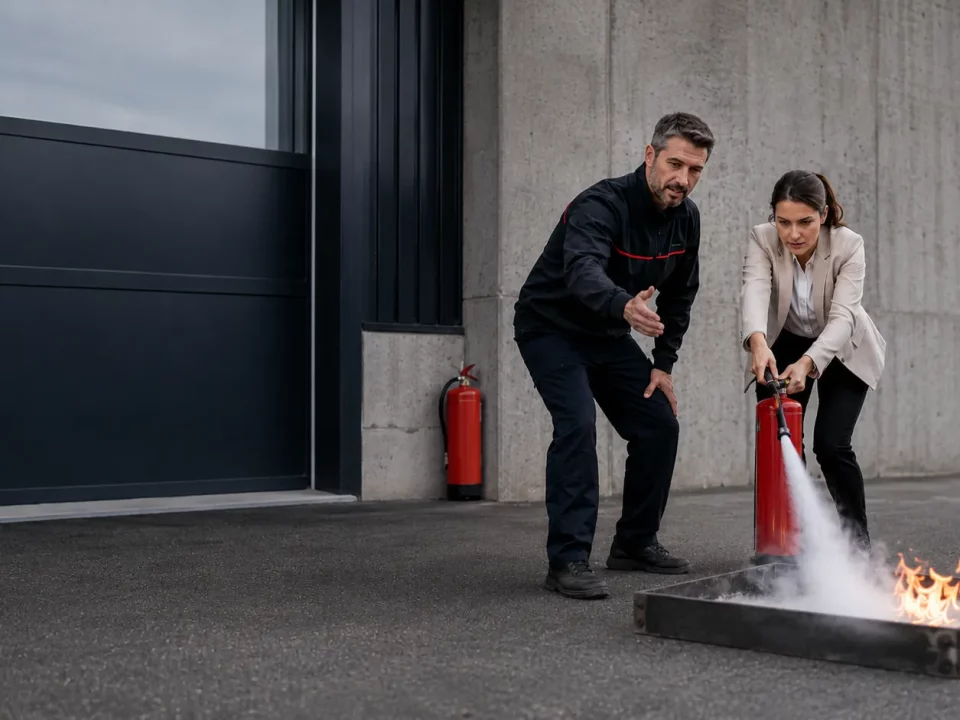
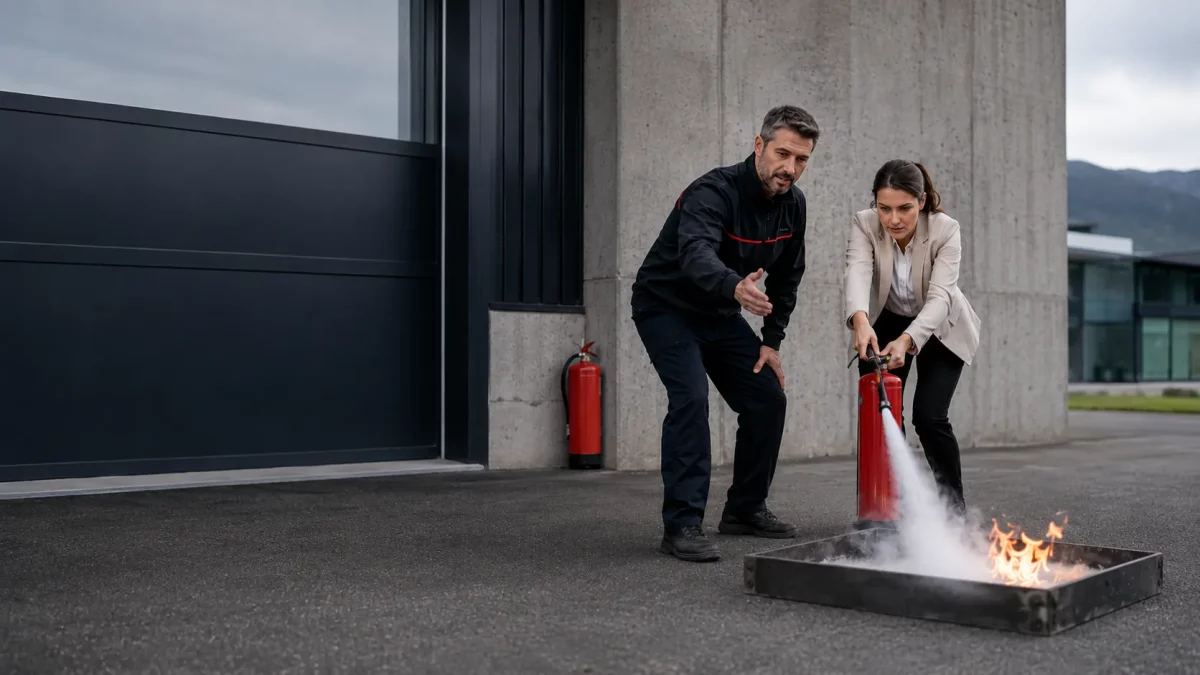
Responding to a fire requires calm and a methodical approach. Here are the steps to follow to use a fire extinguisher correctly:
1. Assess the situation
Before taking any action, make sure that:
- the fire is small and contained;
- you have the right type of fire extinguisher;
- an emergency exit is accessible nearby.
2. Remove the safety pin
Pull the safety pin to release the operating handle. Hold the extinguisher firmly by the handle.
3. Test the extinguisher briefly
Point the nozzle away from the fire and press lightly to test the spray. This checks that the extinguisher is working properly.
4. Aim at the base of the flames
Stand at a safe distance (2 to 3 metres), point the nozzle towards the base of the fire, never at the flames themselves.
5. Sweep from side to side
Press the trigger and sweep from left to right across the base of the fire. Continue until the fire is completely extinguished or the extinguisher is empty.
Mistakes to avoid when using a fire extinguisher
Failing to identify the type of fire
Using the wrong fire extinguisher can make the fire worse. For example, using a water extinguisher on an electrical fire is dangerous.
Read our guide to identifying the type of fire with confidence.
Aiming at the flames instead of the base
The flames themselves cannot be extinguished. To be effective, you must cut off the source of combustion at its base.
Getting too close to the fire
A fire can intensify suddenly. Keeping a safe distance allows you to act while remaining protected.
Forgetting to raise the alarm
Using a fire extinguisher does not replace calling the emergency services. In Switzerland, always dial 118 as soon as the fire starts.
Turning your back on the fire
Even if the fire appears to be under control, it may flare up again. Always retreat carefully while keeping an eye on the fire.
Why fire extinguisher training is essential
React more quickly in an emergency
Training in the use of fire extinguishers helps you develop the right reflexes: quickly identifying the type of fire, choosing the right extinguisher and using it without hesitation. This expertise can make the difference between a contained incident and a major disaster.
Reduce risks to yourself and others
With the right training, you can intervene safely without putting yourself at risk or making the situation worse. You also protect your colleagues, customers and loved ones by limiting smoke, burns and chaotic evacuations.
Meet legal requirements
In Switzerland, businesses must train a certain number of employees in firefighting, notably in accordance with AEAI and CFST standards. Completing training with SafetyFirst helps ensure regulatory compliance and strengthen your organisation’s safety culture.
Conclusion: mastering fire extinguisher use is a vital and accessible skill
Knowing how to use a fire extinguisher is about far more than theoretical learning: it means acquiring a decisive skill for responding quickly and preventing disaster. This seemingly simple action must be practised, understood and incorporated through certified fire safety training.
At SafetyFirst, our workplace training courses in French-speaking Switzerland prepare you to deal with emergencies methodically, calmly and effectively.
Further reading:
- Emergency evacuation training → to organise a rapid and safe evacuation.
- Initial occupational health and safety audit → to assess fire-related risks in your organisation.
FAQ: everything you need to know about using a fire extinguisher
How do I know which fire extinguisher to use for each type of fire?
Each fire extinguisher is designed for a specific type of fire:
Fires involving solid materials (class A) → water or foam extinguisher.
Liquid fires (class B) → foam or powder extinguisher.
Fires caused by electrical equipment → CO₂ or powder extinguisher.
Can you use a fire extinguisher without training?
In theory, yes, but incorrect handling can be dangerous. Training teaches you to respond effectively without putting people or property at risk.
Where are fire extinguishers located in a business?
They must be visible, easily accessible and located near exits, in high-risk areas (kitchens, workshops, etc.). Their location is regulated.
When should a fire extinguisher be serviced?
A fire extinguisher must be inspected annually by an approved professional and serviced every five years (or more often, depending on the model).
What is the service life of a fire extinguisher?
A fire extinguisher generally has a service life of 10 to 20 years, depending on its type and regular maintenance.