How to organise a fire evacuation drill at your company?
02/06/2026
Where to Place a Defibrillator in a Workplace?
30/07/2026
In Switzerland, a defibrillator is not mandatory in every workplace. There is no general, uniform obligation requiring every employer to install an AED, also known as an automated external defibrillator.
However, employers must organise first aid in a way that is appropriate to their activities, risks, workforce and premises. In some contexts, installing a defibrillator is therefore strongly recommended as a preventive measure, even though it is not automatically required.
Considering equipping your premises? SafetyFirst supports businesses in French-speaking Switzerland with the sale, installation and maintenance of AEDs, including advice on location, accessories, equipment monitoring and employee training.
Is a defibrillator mandatory in Swiss workplaces?
The short answer: no, not in every case
Swiss law does not impose a general obligation to install a defibrillator in every workplace. A small administrative organisation, workshop, hotel, school or industrial site is not subject to a single rule that simply states: “an AED is mandatory as soon as there is one employee”.
The right question is therefore not simply: “Is a defibrillator mandatory in Swiss workplaces?”
The real question is: does the current first-aid organisation allow a rapid response in the event of cardiac arrest or a life-threatening emergency?
This analysis should guide the decision.
What the law actually requires from employers
The reference provision is Article 36 of Ordinance 3 to the Employment Act on first aid. It stipulates that the necessary first-aid resources must be available at all times, taking into account:
- the hazards associated with the operation;
- the size of the organisation;
- its location;
- the areas where working conditions require accessible equipment.
In other words, employers must establish a first-aid organisation that is consistent with the reality of their business. A defibrillator may form part of this organisation when the risk, number of people present or emergency response time justifies it.
Defibrillator, AED: what are we talking about?
A device designed for use in the event of cardiac arrest
An AED is an automated external defibrillator. In practice, this term refers to the same type of device as a defibrillator.
Its purpose is to analyse the heart rhythm of a person in cardiac arrest and indicate whether an electric shock should be delivered. Modern models guide the user with voice and visual prompts. They are designed to prevent a shock from being delivered when the situation does not require it.
A defibrillator does not replace professional emergency services. It is used during the first few minutes, before the ambulance arrives, alongside calling 144 and performing cardiopulmonary resuscitation.
Why rapid intervention is critical
When cardiac arrest occurs, response time is critical. Suva points out that even in urban areas, an ambulance may take 10 to 15 minutes to arrive. During this time, people present in the workplace are the first links in the chain of survival.
This is why an AED that is accessible, known to staff and incorporated into the emergency plan can make a real difference. The device alone is not enough: it must be visible, maintained, clearly signposted and supported by clear instructions.
What does Suva recommend regarding defibrillators in the workplace?
No general obligation, but good reasons to get equipped
Suva has issued specific recommendations on the purchase and use of AEDs. It states that businesses are not subject to a general obligation to get equipped, but that they may have good reasons to do so.
The recommendation is clear: a defibrillator is particularly useful in places where large numbers of people gather, in businesses open to the public or in sectors where it may otherwise be difficult to guarantee a rapid response.
An AED must be integrated into the emergency plan
Buying a defibrillator is not enough. Suva recommends integrating it into the company’s emergency plan. This includes defining:
- where the device is installed;
- who knows where to find it;
- who checks its condition;
- how employees are informed;
- how the call to 144 is organised;
- how AED use is coordinated with cardiopulmonary resuscitation;
- how maintenance is carried out.
This approach is consistent with SafetyFirst’s philosophy: an AED project is not limited to selling a device. It must include installation, signage, monitoring of batteries and pads, and team preparation.
When is installing a defibrillator strongly recommended?
Businesses with large numbers of people on site
The greater the number of people present, the greater the likelihood that a cardiac emergency will occur. A defibrillator is therefore particularly relevant in businesses and establishments that regularly welcome:
- large numbers of employees;
- visitors;
- customers;
- pupils or students;
- event participants;
- members of the public passing through.
Examples include administrative headquarters, schools, training centres, shopping centres, hotels, restaurants, sports facilities, cultural venues and public authorities.
Sectors specifically mentioned in the recommendations
Suva relays the recommendations of the Swiss Heart Foundation for several sectors where installing defibrillators is particularly advisable:
- fire and police services;
- transport companies;
- railways, airlines, shipping companies and coach operators;
- public authorities;
- schools and universities;
- shopping centres and department stores;
- hotels and restaurants;
- large sporting or cultural events;
- leisure venues such as swimming pools, casinos, cinemas and nightclubs.
These examples do not mean that other businesses are excluded. They mainly illustrate situations where having an AED on site is an obvious preventive measure.
Remote or difficult-to-access sites
A defibrillator may also be relevant when emergency services are likely to take time to arrive or reach the victim. This applies to:
- isolated sites;
- large industrial areas;
- warehouses;
- construction sites;
- multi-storey buildings;
- mountain sites;
- premises with secure or controlled access;
- businesses operating at night or with extended hours;
- isolated workstations.
In these situations, the business must consider whether its organisation really allows for a rapid response. If the nearest AED is too far away, poorly signposted or inaccessible outside opening hours, it does not meet the operational need.
How can you decide whether your business should get equipped with an AED?
Assessing the risks specific to the activity
The decision should begin with a simple risk assessment. A business does not need the same level of equipment if it operates offices, a workshop, a professional kitchen, a sports facility or an industrial site.
The criteria to consider include:
- the number of people present on site;
- the presence of members of the public;
- the average age or vulnerability of the people accommodated;
- the physical effort required;
- electrical risks;
- working at height;
- lone working;
- night-time work;
- constraints on access to the building;
- the distance from emergency services;
- the presence of other AEDs in the immediate vicinity.
This assessment can form part of a broader occupational health and safety process, for example as part of an initial occupational health and safety audit or an MSST concept.
Checking the actual time needed to reach the defibrillator
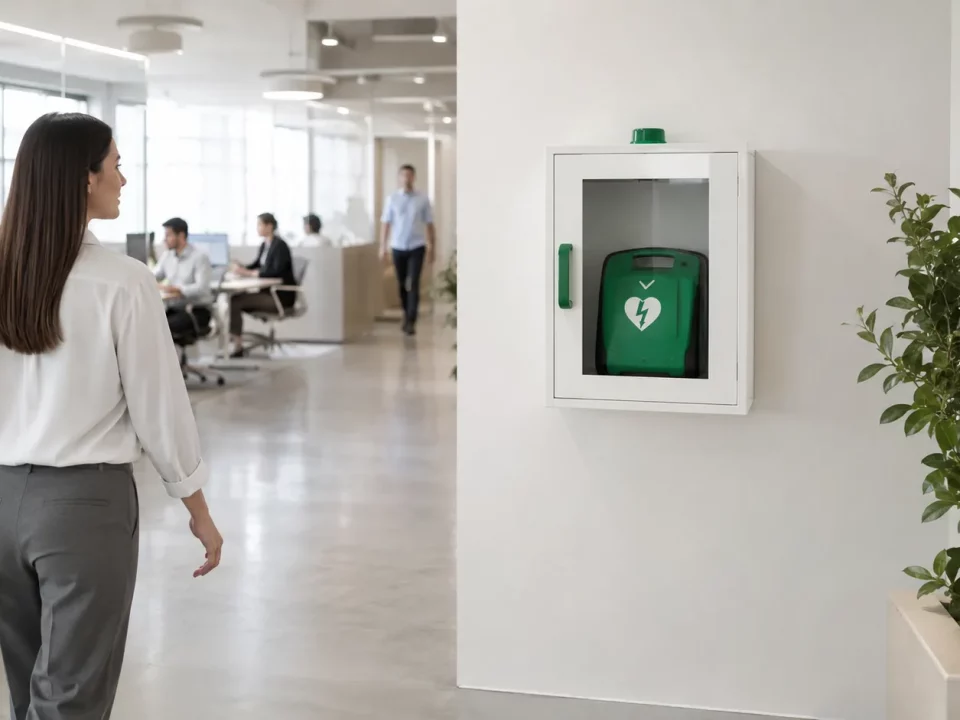
An AED is only useful if it can be reached quickly. It should not be locked inside a closed office, hidden in an unmarked cabinet or placed in an area known only to a few people.
To assess the right location for your defibrillator, ask yourself some very practical questions:
- How long does it take to reach the device from the busiest areas?
- Is the route straightforward, even under stress?
- Is the defibrillator visible from a thoroughfare?
- Do employees know where it is?
- Is the device accessible during all operating hours?
- Can an external person locate it if the business welcomes members of the public?
In a large building, several devices may be more appropriate than a single defibrillator placed at reception.
Documenting the decision in the first-aid plan
Even when a defibrillator is not legally mandatory, it is useful to document the decision. This enables the employer to demonstrate that the matter has been assessed seriously.
The first-aid plan can specify:
- the risks identified;
- the number of first aiders or trained people;
- the first-aid resources available;
- the location of the defibrillator or defibrillators;
- the alert procedures;
- inspection responsibilities;
- the training arrangements;
- the battery and pad maintenance intervals.
This documentation prevents an improvised approach. It turns the purchase of an AED into an organised, traceable measure adapted to the site.
Installing a defibrillator in the workplace: points not to overlook
Choosing an accessible and visible location
The right location is central, visible and easy to reach. In a business, a defibrillator can be installed near reception, a busy area, a changing room, a staff restaurant, an internal gym or an assembly point.
The location should take account of high-risk areas and actual people flows. A device placed in a locked technical room or on a rarely used floor may be useless at the critical moment.
Signage is also essential. A stressed employee should not have to search for the device. They must be able to identify it immediately.
Planning for defibrillator maintenance
A professional defibrillator generally performs self-tests, but this does not replace organised monitoring. Pads and batteries have a limited service life. After use, certain consumables must be replaced.
Maintenance must include:
- visual inspection of the device;
- checking the status indicator;
- monitoring expiry dates;
- replacing the pads;
- replacing the batteries;
- checking the cabinet;
- keeping records of inspections;
- an intervention after use.
This point is often underestimated. An AED that is purchased and then forgotten loses part of its value. The business must be able to guarantee that the device is operational on the day it is needed.
Training employees to act without hesitation
A modern AED can be used by someone without medical training. The device guides the user and will not deliver a shock unless the necessary conditions are met.
However, in a real-life situation, hesitation wastes time. Training helps people recognise cardiac arrest more quickly, call 144, start cardiopulmonary resuscitation and use the defibrillator with greater confidence.
For businesses, a certified BLS-AED-SRC course is particularly relevant. It prepares employees to respond according to Swiss standards and coordinate essential actions until emergency services arrive.
The Swiss Resuscitation Council has also published its SRC 2025 course guidelines, with uniform principles for BLS-AED courses in Switzerland. This confirms the importance of combining equipment with up-to-date training.
A simple method for deciding whether your business should install a defibrillator
1. Identify the people present
Start by estimating the number of people present each day: employees, visitors, customers, suppliers, pupils, patients or participants. A business that welcomes members of the public does not face the same level of exposure as a closed office with a few employees.
2. Identify high-risk areas
List the places where an incident could occur: workshop, production area, kitchen, gym, car park, reception, event space, loading area or isolated floor. The aim is to check whether an AED could be reached quickly from these locations.
3. Estimate the emergency response time
Even with good healthcare coverage, the first few minutes often depend on the people present. If your site is remote, difficult to locate or complex to navigate, the value of a defibrillator increases.
4. Check internal skills
How many people know how to perform cardiopulmonary resuscitation? Who knows the Swiss emergency number 144? Who knows how to use an AED? A business that is equipped but unprepared remains vulnerable.
You can complement the equipment with certified first-aid training to strengthen your organisation’s internal response capability.
5. Organise ongoing monitoring
The decision does not end with the purchase. You need to plan installation, staff information, inspections, maintenance and training updates. This is what makes the system reliable over time.
Defibrillator in the workplace: legal requirement or sensible preventive measure?
Compliance is not always enough
Focusing solely on whether a defibrillator is mandatory can lead to an overly narrow answer. Legally, the absence of a general obligation is important. But when it comes to first aid, minimum compliance does not always meet the actual need.
A responsible business must be able to demonstrate that its emergency response organisation is appropriate. For some sites, a first-aid kit and trained personnel may be sufficient. For others, an accessible AED is a logical measure.
The right choice depends on the situation on site
A defibrillator is particularly relevant if your business has several of the following factors:
- large workforce;
- large numbers of members of the public;
- large premises;
- physical activities;
- specific occupational risks;
- distance from emergency services;
- extended hours;
- lone working;
- high occasional visitor numbers.
In these cases, the AED should not be viewed as an isolated purchase, but as one component of the emergency plan.
Moving from assessment to equipment
If the assessment shows that a defibrillator is appropriate for your business, the next step is to choose a suitable device, define its location, plan the signage, organise maintenance and train employees.
SafetyFirst offers a complete solution for the sale, installation and maintenance of AEDs for businesses, schools, retailers, public authorities, sports facilities and establishments open to the public in French-speaking Switzerland.
Frequently asked questions about defibrillators in Swiss workplaces
Is a defibrillator mandatory in a Swiss SME?
No, not as a general rule. A Swiss SME is not automatically required to install a defibrillator. However, it must organise first aid in a way that is appropriate to its risks, workforce and location. If emergency services may take time to arrive or the site welcomes large numbers of people, an AED may be strongly recommended.
Does a Swiss employer have to install an AED?
Employers must ensure that first-aid resources are available at all times. The law does not state that these resources must always include a defibrillator. An AED becomes relevant when the risk assessment shows that the response to cardiac arrest needs to be strengthened.
Who can use a defibrillator in the workplace?
A modern automated external defibrillator can be used by someone without medical training. The device provides voice and visual instructions. Training is nevertheless recommended to recognise the emergency, call for help, perform cardiopulmonary resuscitation and use the AED without hesitation.
Where should a defibrillator be placed in a workplace?
The defibrillator should be placed in a visible, signposted, central location that can be reached quickly. It should be known to staff and accessible during operating hours. In large buildings or on extensive sites, several locations may be necessary.
Should employees be trained if the business installs an AED?
Yes, this is strongly recommended. Even though the device is designed to guide the user, training improves response speed and coordination. Trained employees know how to alert emergency services, start chest compressions and use the defibrillator in the correct order.
What is the difference between the French abbreviations DAE and DEA and the English term AED?
AED stands for Automated External Defibrillator. DAE and DEA are French abbreviations used for the same type of device. In the context of a Swiss workplace, these terms refer to an automated external defibrillator.
Is a defibrillator enough to comply with first-aid requirements?
No. A defibrillator alone does not guarantee a proper first-aid organisation. It must be integrated into a broader system: an emergency plan, first-aid equipment, trained personnel, clear instructions, signage, maintenance and rapid access to professional emergency services.
How can I learn to use a defibrillator?
You can start by consulting a practical guide on using an AED in an emergency and supplementing it with practical training. The key actions are calling 144, performing cardiopulmonary resuscitation and using the defibrillator quickly. To strengthen your basic knowledge, you can also read SafetyFirst’s advice on cardiopulmonary resuscitation techniques.